
5 Ways to make $10k/month in 30 days with AI
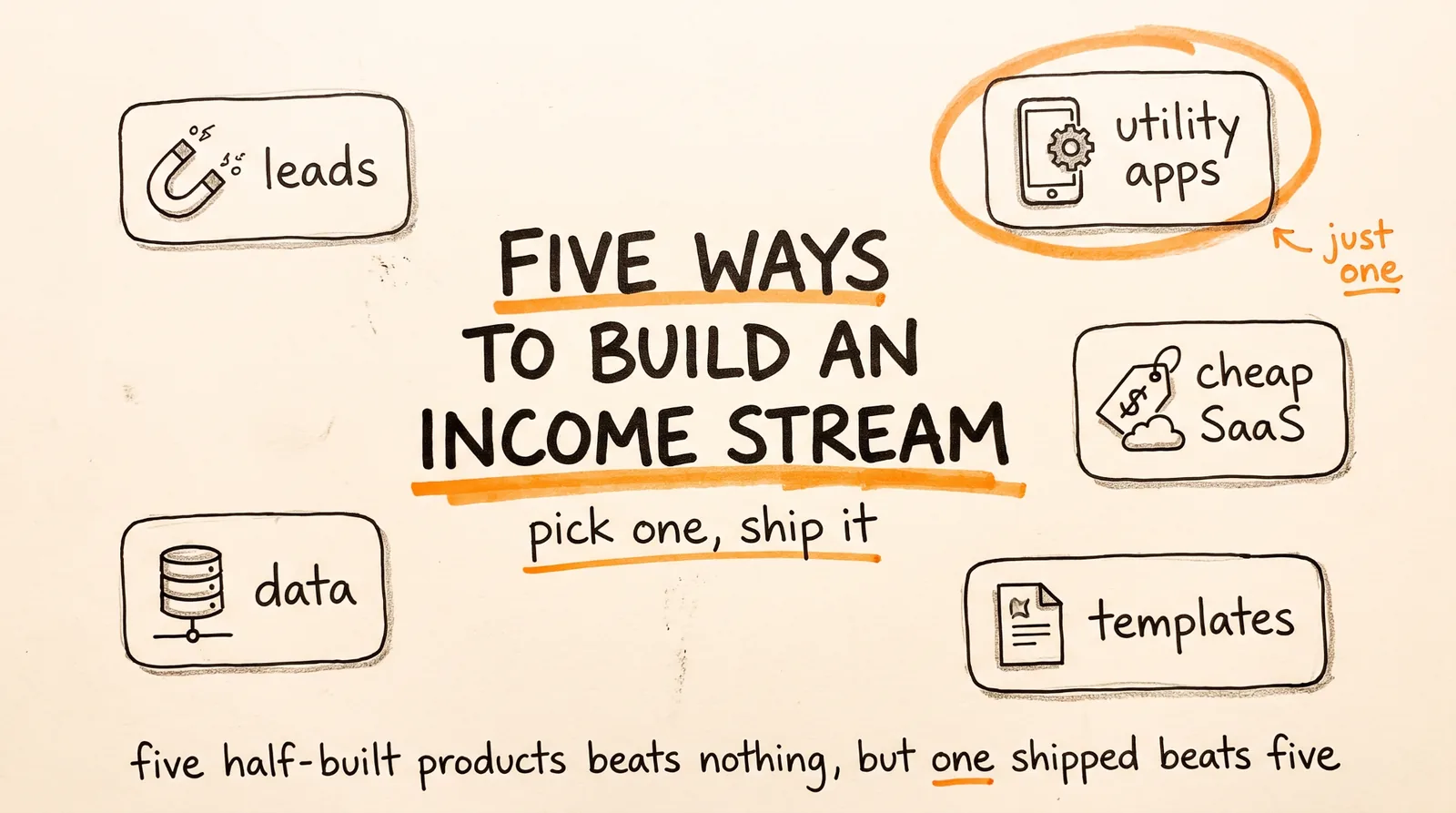
This is the full guide from the video. Five business models people are genuinely running with AI right now, with the research prompt, the build prompt, and the honest trap for each one.
Read the next paragraph before anything else, because it decides whether this works for you.
Pick one. Not five. Every one of these is a real business, and each one takes the same thing: a validated demand signal, a built thing, and someone to sell it to. Building all five means five half-finished products and no customers. The people making money with these picked the one that fit what they already knew and shipped it while everyone else was still choosing.
And on timelines, straight: none of these pay $10K in month one. What month one buys you is a shipped product and your first few customers. The numbers in this guide are what these models produce once they are running, and the ramp is normally three to six months of consistent work. Anyone telling you otherwise is selling you the dream rather than the business.
Don't want to figure this out alone? Join the Skool → skool.com/raycfu
Play 1: The Lead Generation Factory
The model: you build qualified lead lists for service businesses in a specific niche and city, and sell them on subscription. Dentists in New York. Carpenters in Seattle. Roofers in Phoenix.
It works because service businesses live and die on lead flow, they are terrible at generating it themselves, and one closed job often pays for a year of your service.
The research prompt:
Research the [SERVICE BUSINESS TYPE] market in [CITY]. Find: how many businesses of this type operate there, what an average job is worth to them, what they currently pay per lead through Angi, Thumbtack, or Google Ads, and what their typical close rate on an inbound lead is.
Then tell me what a genuinely qualified lead is worth to this business, and what I could charge for a monthly package of them without being more expensive than what they use now.
Also tell me why this niche might be a bad choice, if it is.
The build: you need a repeatable way to find people actively looking for that service and a way to verify contact details. Your ICP is the business you sell to, and your product is the leads.
Price it as a monthly package, not per lead, because per lead invites arguments about quality and monthly gets you predictable revenue.
The trap: lead quality is the entire business and the thing that kills most people doing this. A list of names is not leads. If the people on your list did not actually express interest in that service, your client will figure it out in week two and churn. Sell fewer, better leads and offer a replacement guarantee for any that are unreachable or out of area. Also, if you are collecting or passing personal contact data, you need a lawful basis and an opt-out, which is not optional and is easier to build in from day one than to retrofit.
Play 2: The Utility App Factory
The model: people search the App Store thousands of times a month for boring, specific tools. PDF scanner. Duplicate photo remover. Unit converter. If your app exists, ranks, and works, the store's own search sends you customers without you spending on ads.
The research prompt:
Research App Store demand for simple utility apps. Find 10 specific searches with meaningful monthly volume where the top results are rated under 4.0, have not been updated in over a year, or are buried in ads and subscriptions.
For each one: the search term, roughly what the volume looks like, who currently ranks, what users complain about most in their reviews, and what would have to be genuinely better for someone to switch.
Rank them by how weak the incumbents are, not by how big the search is.
The build prompt:
Build [APP CONCEPT] as an iOS app. It solves exactly one problem: [PROBLEM]. Requirements: it does the core job in under three taps, works offline where possible, and does not ask for permissions it does not need. No ads, no upsell before the user has gotten value once. Include the App Store description and keyword list, and a privacy policy that matches what the app actually collects.
Now the trap, and this one is serious enough that I would rather cost you the video's number than let you lose an account.
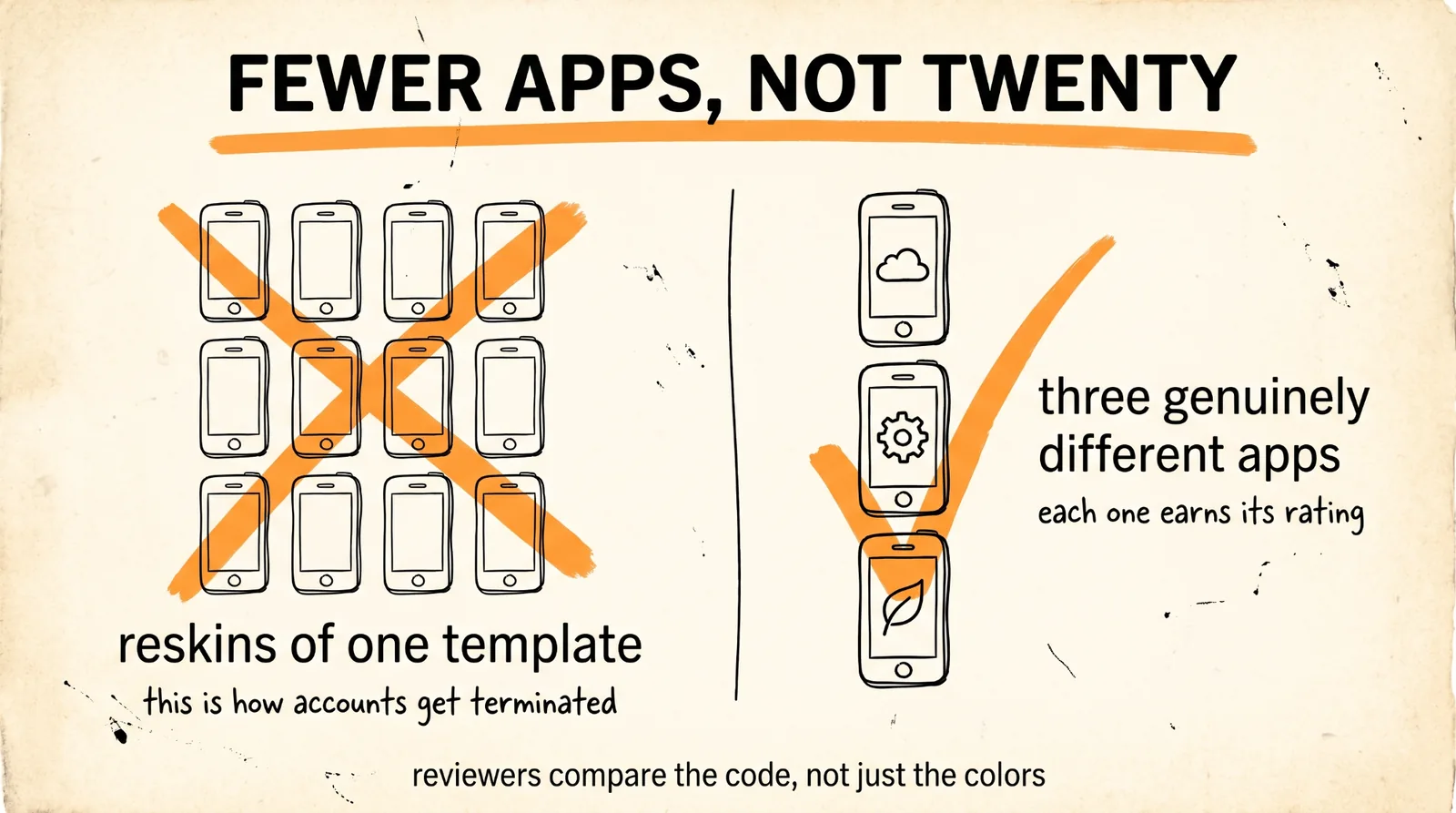
Apple's Guideline 4.3(a) treats duplicate and template-generated apps as spam, and it names the exact pattern: submitting multiple similar apps built from a repackaged template, or several similar apps across accounts. Repeated violations are grounds for removal from the Apple Developer Program, not just a rejected app. And Apple tightened this further in June 2026, adding language that apps in oversaturated categories that are not improved or do not attract customers may be pulled from the store entirely.
So "make 20 of these" is the fastest way to lose everything you built. The version that works is three to five genuinely different apps, each solving a distinct problem, each good enough to earn its rating. Differentiation is not a different color and a different icon, reviewers compare binaries, metadata, and concepts. Fewer, better, and actually maintained.
Play 3: The Inexpensive SaaS Alternative
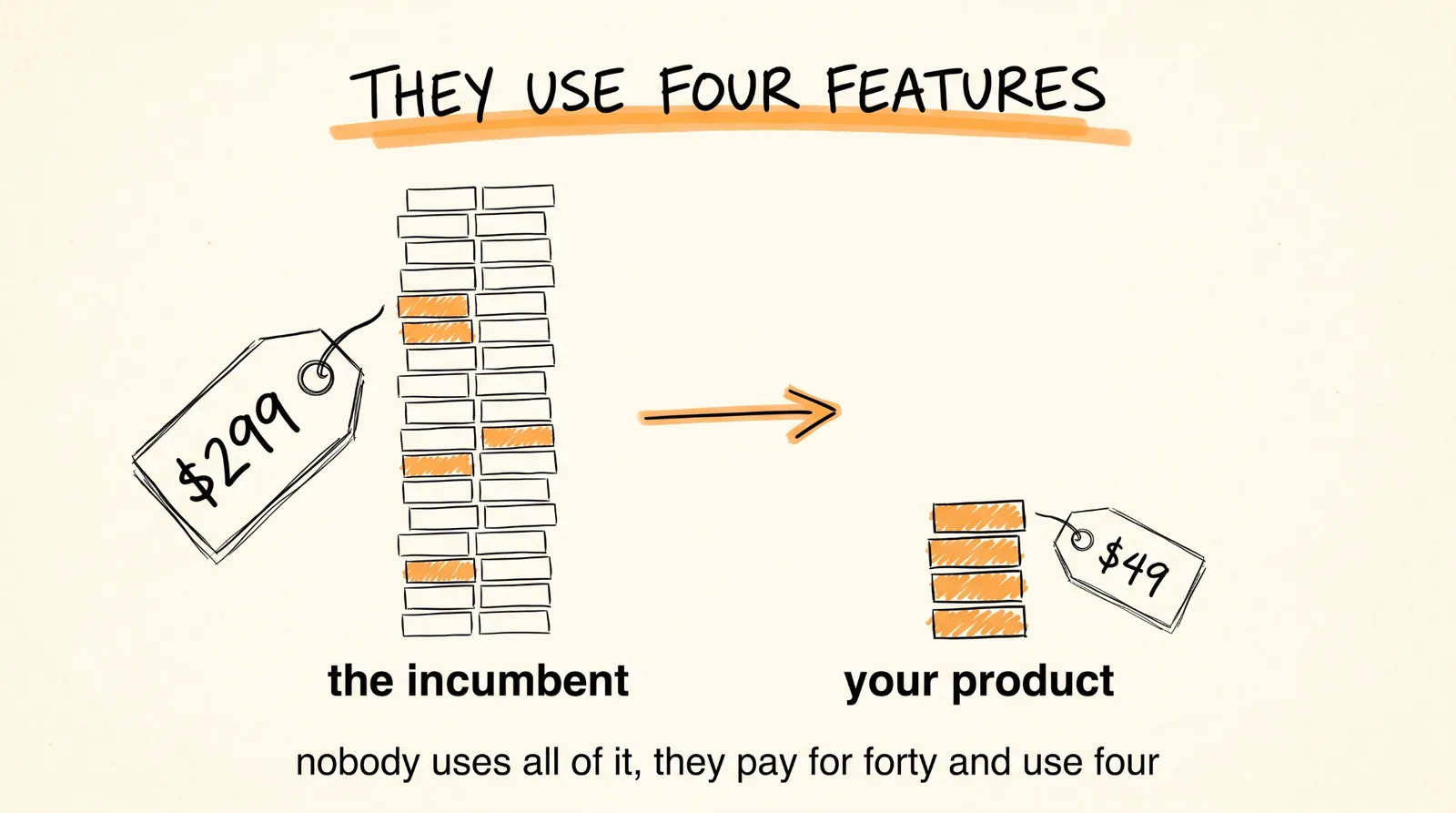
The model: every market has an incumbent charging $299 a month. When it gets acquired, prices go up and support gets worse, and a chunk of its customers start looking. You build the 20 percent of the product they actually use and charge $49.
This is the highest ceiling of the five and the most work.
The research prompt:
Research [SOFTWARE CATEGORY]. Identify the dominant tools, their pricing, and any that have been acquired or raised prices in the last 18 months.
Then read their recent reviews on G2, Capterra, Reddit, and their own community forums, and tell me: the features nearly every user mentions using, the features almost nobody mentions, the complaints that come up repeatedly, and what people say when they cancel.
Finish with the smallest possible product that would satisfy the users who are unhappy, and what it would have to do on day one to be worth switching for.
The insight that makes this work: nobody uses all of a $299 tool. They use four features and pay for forty. Your product is those four features, done well, at a price that makes switching obvious.
The trap: build a competitor, never a clone. Studying a product and rebuilding the functionality people need is normal competition and completely legitimate. Copying their code, their exact interface, their copy, or their brand is not, and it turns a business into a lawsuit. Also be honest with yourself about support, because a SaaS product with paying customers is a support obligation forever, which is why this one pays the most.
Play 4: The Data Product
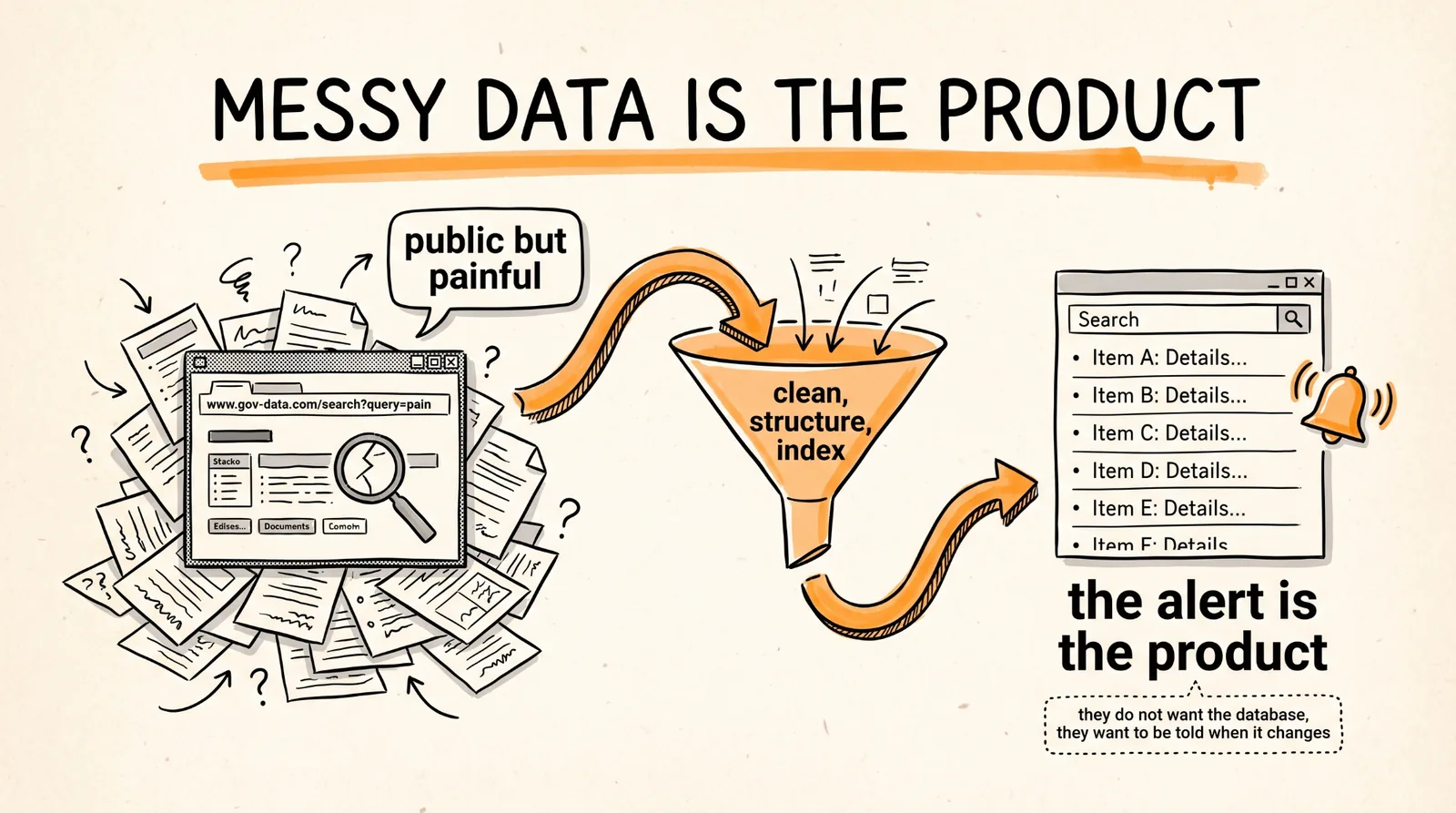
The model: enormous amounts of public data exist and almost all of it is painful to actually use, scattered across bad government portals, inconsistent formats, no search. You clean it, structure it, make it queryable, and sell access.
Court records. Clinical trials. Patent filings. Permit applications. Corporate registrations.
The research prompt:
Research [DATA CATEGORY]. Tell me: where the authoritative public source is, what format it is published in, how often it updates, what the licensing or terms of use actually permit, and what makes it painful to use as published.
Then tell me who currently pays for access to this data in a cleaner form, what they pay, and what specific question they are trying to answer with it.
Flag clearly whether this data is genuinely free to redistribute or whether it is licensed, because the two are very different businesses.
The build: a scheduled job that pulls the source, normalizes it, and loads it somewhere queryable, plus a thin interface, search, filters, alerts, and an export. The alerts are usually the actual product, because most buyers do not want the database, they want to be told when something in it changes.
The trap: "public" and "free to redistribute" are not the same thing. Court records and clinical trials are genuinely public. Real estate transaction data is often licensed through MLS agreements with real restrictions on redistribution. Check the terms of the specific source before you build on it, because a data business built on data you are not allowed to resell has no floor under it.
Play 5: The Digital Product Factory
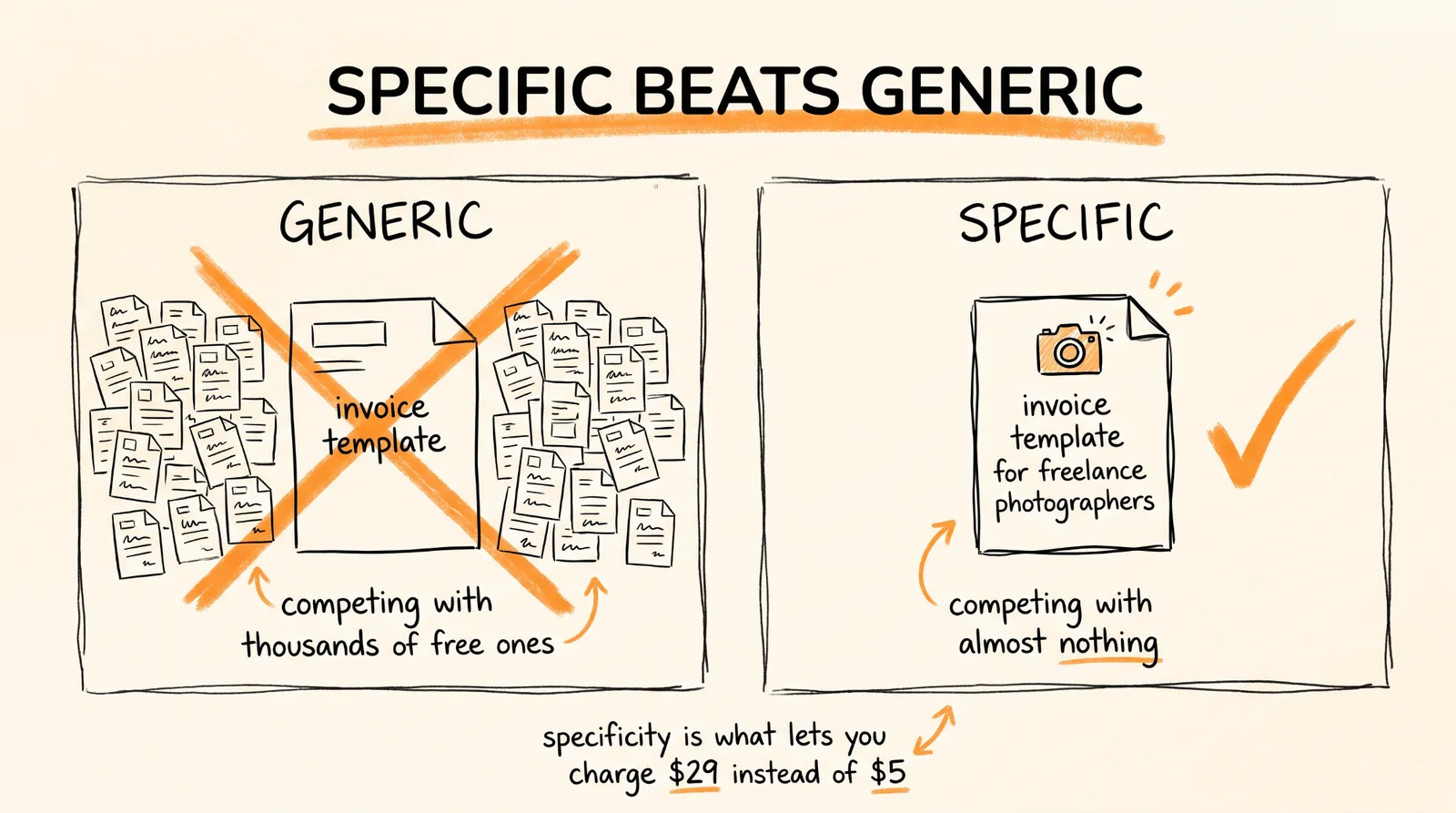
The model: templates people search for constantly. Invoice templates. Content calendars. Budget spreadsheets. Notion systems. You make the good version and sell it for $29 on Gumroad or Etsy.
The lowest barrier of the five, which also means the most competition.
The research prompt:
Research demand for digital templates in [CATEGORY]. Find the specific searches with real volume on Etsy and Google, and for each one look at what currently sells: the price points, what the top listings include, and what buyers complain about in reviews.
Tell me what the best sellers all have in common, and what none of them do that buyers keep asking for.
Then tell me which of these categories is too saturated to enter without something genuinely different.
The build prompt:
Build a [TEMPLATE TYPE] for [SPECIFIC AUDIENCE]. Include: the working template itself with formulas and automations set up, a filled-in example so buyers can see it in use, and a one-page setup guide. Design it for someone who has never used [TOOL] before. The thing that makes it worth $29 rather than free is [THE SPECIFIC ADVANTAGE], so make sure that is obvious in the first 30 seconds.
The trap: the search volume everyone quotes is exactly why it is crowded. A generic invoice template competes with thousands of free ones. An invoice template built specifically for freelance photographers, with the line items photographers actually bill for and the deposit terms they use, competes with almost nothing. Specificity is the entire strategy here, and it is also what lets you charge $29 instead of $5.
How to Actually Pick One
Run this before you build anything:
I am choosing between five business models: a lead generation service for local businesses, simple utility apps, a cheaper alternative to an expensive SaaS tool, a cleaned-up public data product, and digital templates.
Here is my situation: [what you are good at], [how many hours a week you actually have], [what you can spend], [whether you can code], [who you already know or have access to].
For each model, tell me honestly: how well it fits what I already have, how long until the first dollar realistically, what would most likely kill it for someone in my position, and what the first week would actually look like.
Then recommend one, and tell me plainly why the other four are worse for me specifically. Do not hedge.
Then give it 90 days before you judge it. Every one of these fails at week three if you quit at week three.
The Part That Actually Decides It
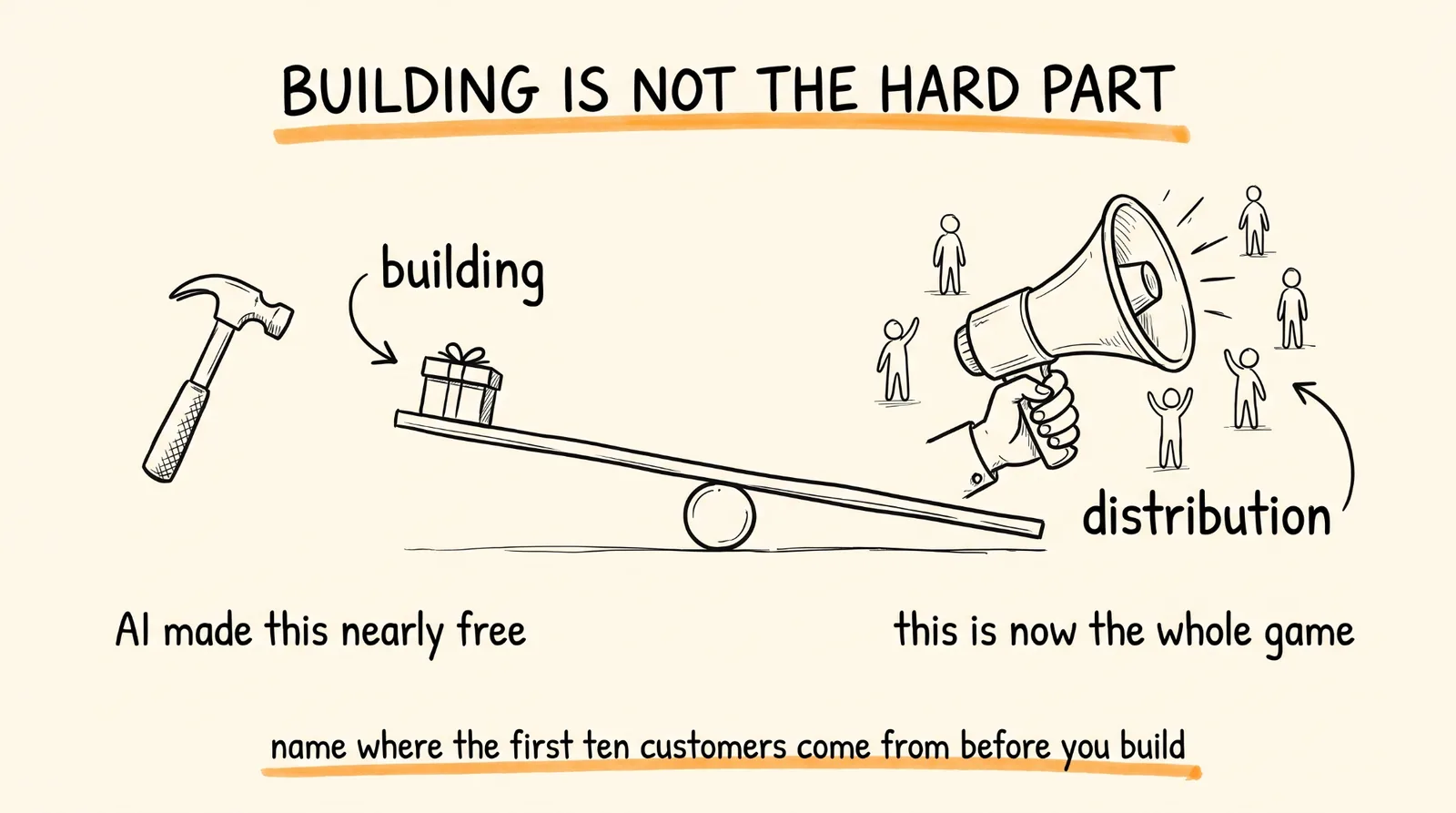
Four of these five die from the same cause, and it is not the build. AI has made building nearly free, which means building is no longer the hard part or the differentiator. Distribution is.
So before you build anything, answer one question: where will the first ten customers come from, specifically, by name or by channel. If the answer is "people will find it," that is not an answer, and no amount of product quality fixes it.
The two plays with distribution built in are the utility apps, where App Store search does the work, and the data product, where the buyers are usually a small identifiable group you can contact directly. The other three require you to go get customers, which is fine, but plan it before you write a line of code.
The Recap
Five models, all real. Lead generation for service businesses, utility apps that ride store search, cheap alternatives to expensive software, cleaned-up public data, and specific digital templates. Each one has a research prompt to validate the demand and a build prompt to make the thing.
Pick one, ship it, give it 90 days, and know where the first ten customers are coming from before you start.
Don't want to figure this out alone? Join the Skool → skool.com/raycfu