
How to Build $25K 3D Games With Astra and Higgsfield
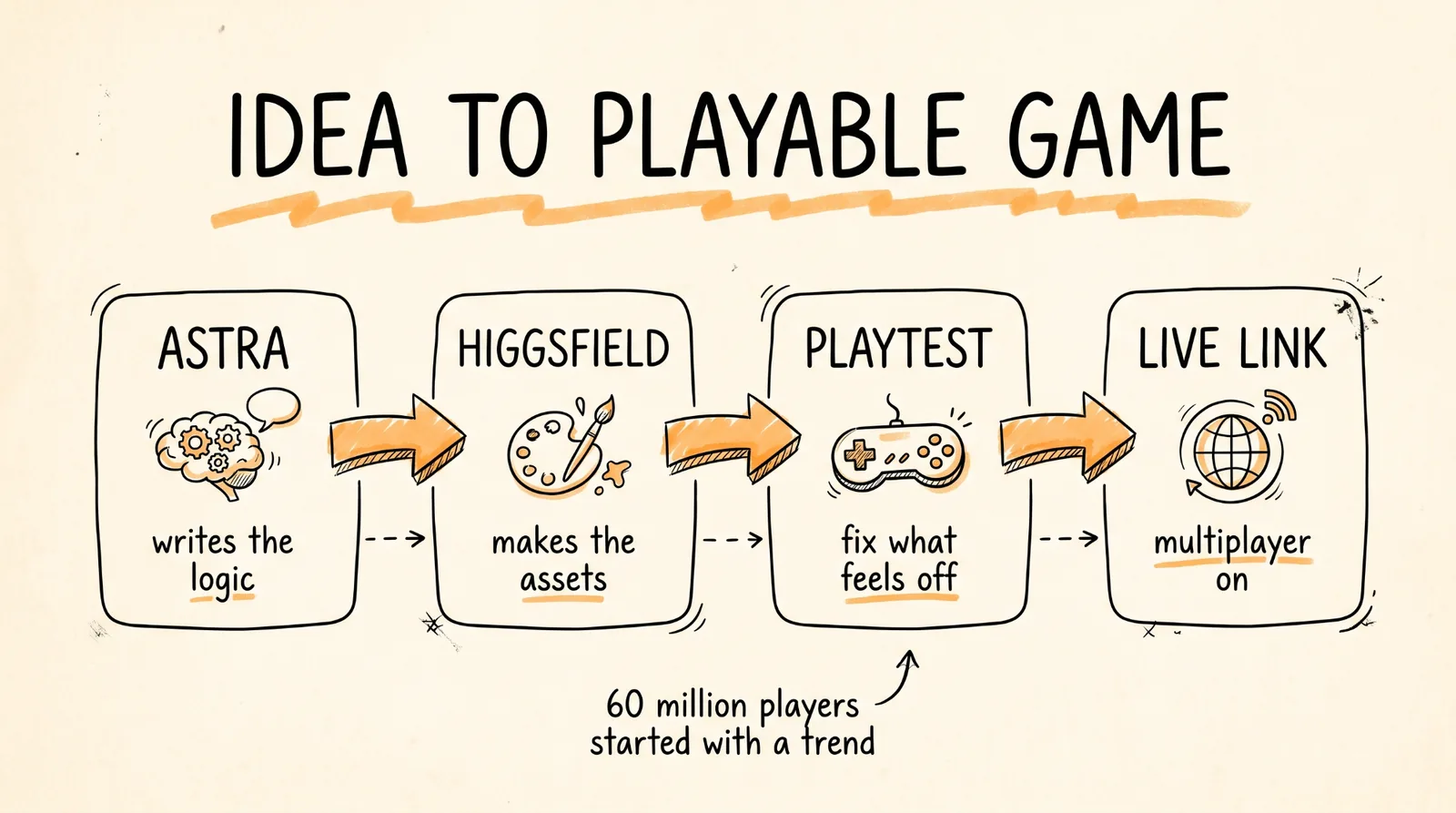
This guide walks you through building a playable 3D browser game with GPT-6 Astra and Higgsfield, from idea to a live multiplayer link, and then shows you where the money actually comes from. You get five copy-paste prompts, the ChatGPT and Higgsfield setup, the playtest loop, and the distribution playbook that turned one AI-built game into 60 million players. First playable build takes an afternoon. A game worth selling takes a week or two of refining.
Don't want to figure this out alone? I walk members through every step inside the community. Join the Skool → skool.com/raycfu
Where the $25K Story Comes From
A game developer named Anul Agarwal was laid off in late 2022. In 2023 he saw the Watermelon Suika game trending, used ChatGPT to write all of the code and generate all the fruit art, and built his own version in Unity. It hit number one on Coolmath Games mobile, passed 50 million players across web platforms, and earned over $25,000.
Three lessons from that story shape this whole guide:
He did not invent a game. He made a better version of one that was already trending.
The AI did the code and the art. He did the polish and the judgment.
The money came from distribution. Web game sites like Coolmath Games, GameDistribution, and GamePix paid him through ad revenue sharing and one-time license fees of $1,500 to $2,500 per game.
He did this with 2023 tools, copying and pasting code by hand. Astra plus Higgsfield now does the building, the art, and the hosting for you. The distribution playbook has not changed.
What You Need
ChatGPT with GPT-6 Astra. Astra is available on paid ChatGPT plans. Plus works to start. Pro gives you much more usage for long builds.
The ChatGPT desktop app for Mac or Windows. The Higgsfield plugin installs inside the desktop app.
A Higgsfield account with credits. Every character, texture, sound, and animation costs credits. Check your plan at higgsfield.ai/pricing before a big build.
Optional, for the advanced route: Codex and Blender, Unity, or Unreal Engine installed on your computer.
About an afternoon for your first build.
Step 1: Pick a Game That Is Already Working
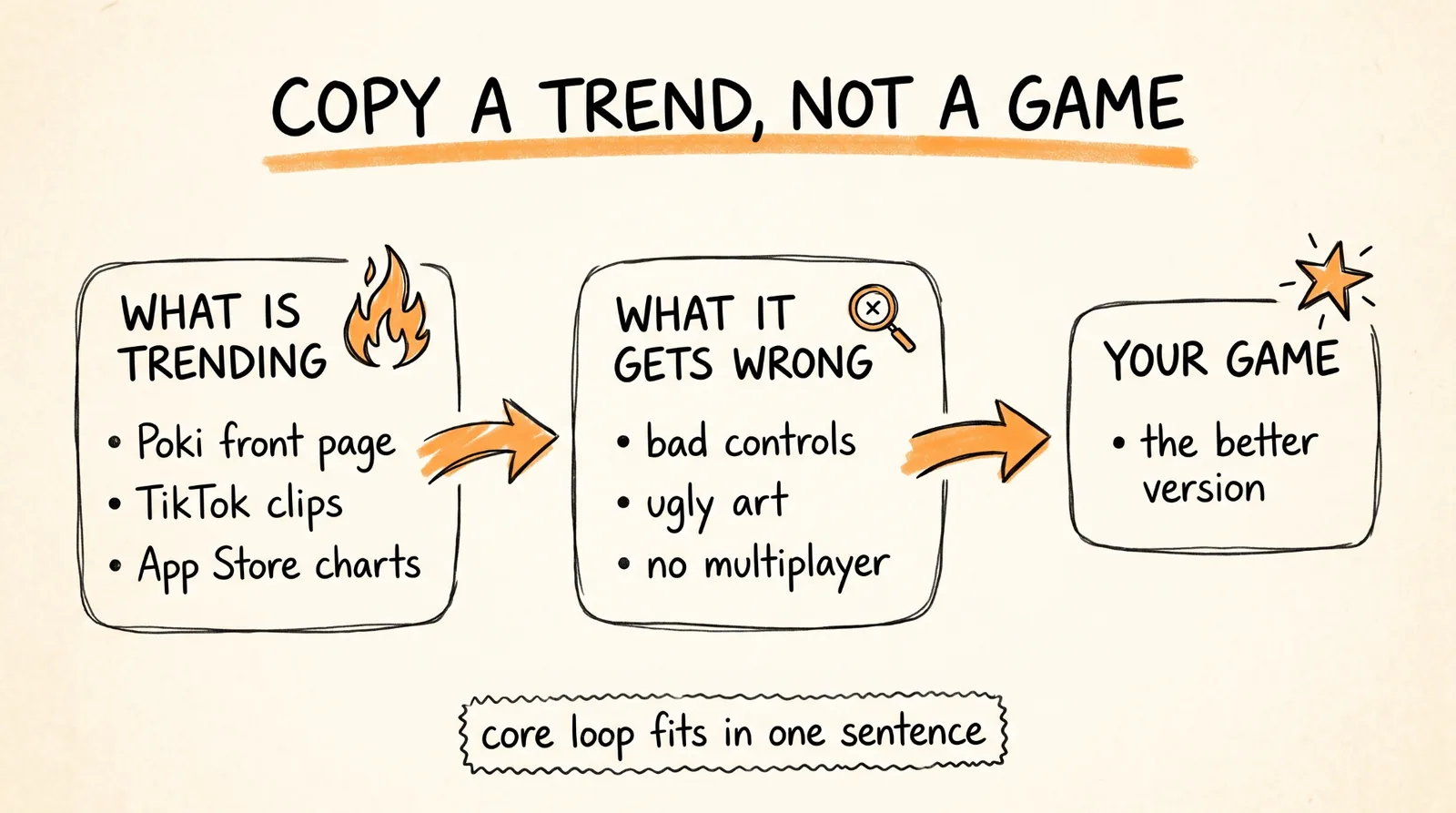
The fastest way to fail is to build your dream game. The fastest way to get players is to build a better version of something already getting millions of views.
Go look at what is trending right now:
The front pages of Poki, CrazyGames, and Coolmath Games. Sort by new or popular.
TikTok and YouTube Shorts searches for "satisfying game," "addictive browser game," and "one more try."
Top charts in the App Store puzzle and casual categories.
Look for simple core loops that fit in one sentence. Drop fruit and merge them. Dodge obstacles and survive longer. Push other players off a platform. Race three laps. Simple loops are cheap to build, easy to understand in a 10-second clip, and the kind of game portals want most.
Then write down what the top version gets wrong. Bad controls, ugly art, no multiplayer, too many ads, gets boring after five minutes. That gap is your game.
Step 2: The Game Brief (Prompt 1)
Open ChatGPT, pick GPT-6 Astra, and paste this. It makes Astra interview you before it builds anything, so the first build is close to what you want.
I want to build a 3D browser game. Before you build anything, ask me 10 questions, one at a time, to lock down the design. Cover these areas:
1. The core loop: what the player does over and over
2. The goal: how you win, lose, or score
3. Controls on desktop and on mobile
4. Single player, local, or online multiplayer
5. The visual style (low-poly, voxel, cartoon, realistic, pixel)
6. The setting and mood
7. The player character and any enemies or NPCs
8. How a round starts and ends, and how long one round lasts
9. What makes players want to play one more round
10. What existing game this is closest to, and what I want to do better
After my 10th answer, write a one-page game design brief with all of it, a list of every asset the game needs (characters, environments, props, textures, animations, sounds, music), and a plan for the first playable build. Do not start building until I approve the brief.
Here is my idea: [DESCRIBE YOUR GAME IN ONE OR TWO SENTENCES]
Answer honestly. "I don't know" is fine, and Astra will suggest options. When the brief comes back, read it like a producer. Cut anything that is not the core loop. You can add features later. You cannot get back a week spent on a feature nobody uses.
Step 3: Connect Higgsfield
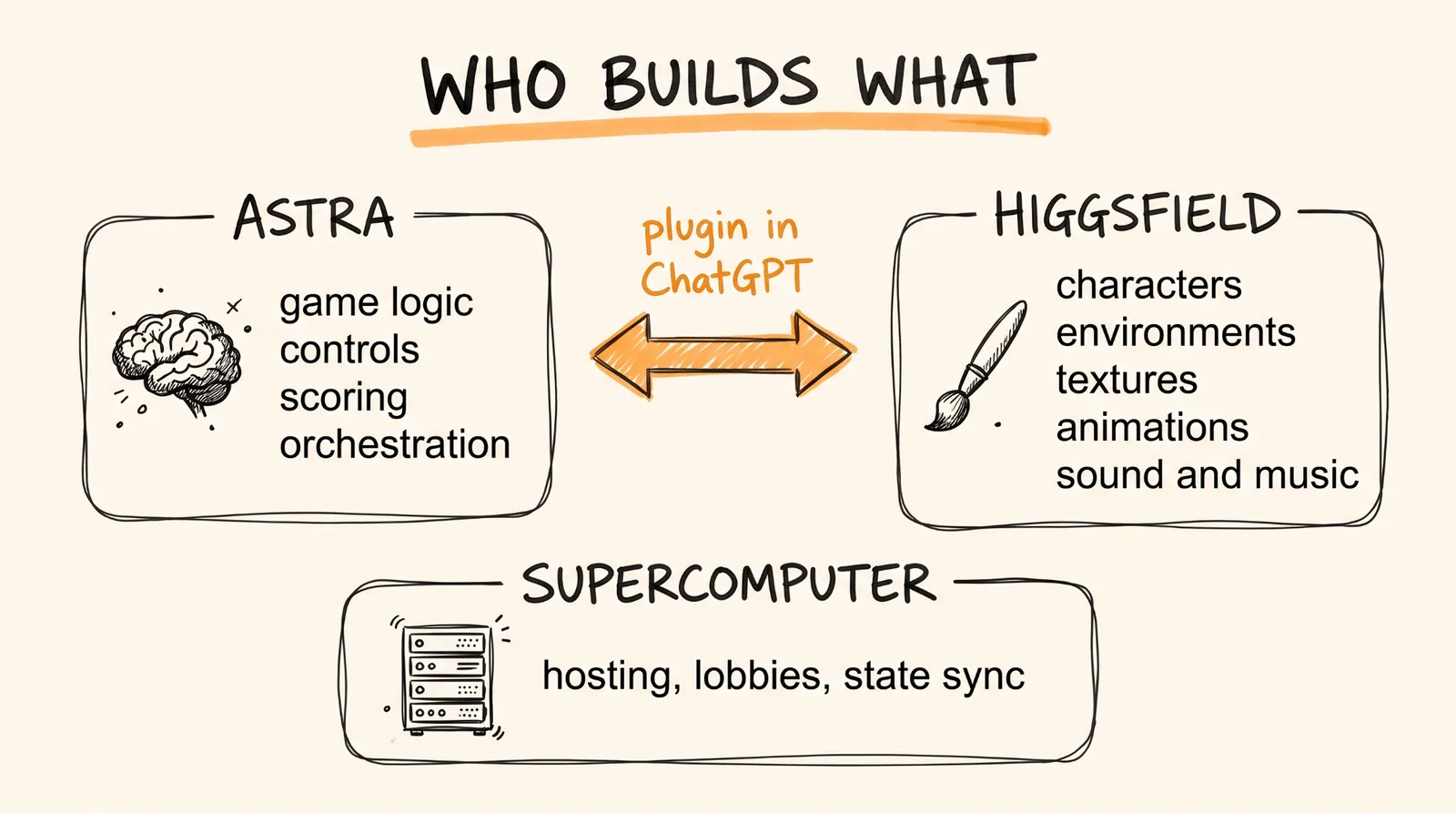
Astra writes the game logic. Higgsfield generates the stuff you see and hear: characters, environments, props, textures, 3D models, animations, cutscenes, sound effects, and music. Higgsfield hosts dozens of image, video, 3D, and audio models and picks the right one for each asset, so you do not have to know which model makes the best character versus the best terrain.
There are two ways in.
Through ChatGPT:
1. Download the ChatGPT desktop app and sign in.
2. Go to higgsfield.ai/mcp and open the ChatGPT Plugin tab.
3. Follow the steps to install the Higgsfield plugin inside the desktop app, then sign in with your Higgsfield account.
4. Start a new chat with Astra selected and say "Use Higgsfield to build a game."
Through Higgsfield Supercomputer:
1. Go to higgsfield.ai/supercomputer and sign in.
2. Open Games. Supercomputer runs the same Games 2.0 system on Astra, with no plugin needed.
3. Pick your Genre (Shooter, Platformer, Novella, Hypercasual, Racing, or Horror), your Style (Pixel Art, Minimalistic, ASCII, Voxel, Anime, or 3D), your Setting (Medieval, Cyberpunk, Retro, Modern, Space, or Fantasy), and flip the Multiplayer toggle before you write anything.
Use ChatGPT if you want to talk through the design with Astra first. Use Supercomputer if you want the fastest path from idea to a playable link.
Step 4: Generate the Assets and First Build (Prompt 2)
Paste your approved brief into the chat with Higgsfield connected, then add this:
Build the first playable version of this game using Higgsfield for every asset.
For assets:
- Generate every character, environment, prop, and texture on the asset list in one consistent art style: [STYLE FROM THE BRIEF]
- Rig and animate the player character with idle, run, jump, and any action from the core loop
- Generate sound effects for every player action and a looping music track that fits the mood
- Keep every asset low-poly enough to run smoothly in a phone browser
For the build:
- Start with only the core loop working end to end. Movement, the main action, scoring, win and lose.
- Add a start screen, a score display, and a restart button
- Make controls work on keyboard and on touch
When it is ready, give me the playable link and a list of anything you simplified or skipped.
The first build will not be perfect. It is not supposed to be. Its only job is to prove the core loop is fun.
Step 5: The Advanced Route (Blender, Unity, Unreal)
The Higgsfield route builds browser games that run from a link. If you want a game you can export as full project files, ship to Steam or mobile app stores, or license to a web portal as a standalone build, use Astra inside Codex on your own computer.
In Codex, Astra can write and run Blender Python scripts that build geometry, place objects, set up materials, and export 3D models. It can write the C# for Unity or the Blueprints logic and C++ for Unreal, and it can use computer use to operate those apps on your screen. Early users have built full scenes in Blender and moved them into Unreal Engine 5 as walkable levels this way.
Be realistic about this route. It is slower, it uses far more of your Astra quota, and you will spend real time fixing things inside the engine yourself. Start on the Higgsfield route, prove the game is fun, then move to an engine if the game earns it.
Step 6: Playtest and Refine (Prompt 3)
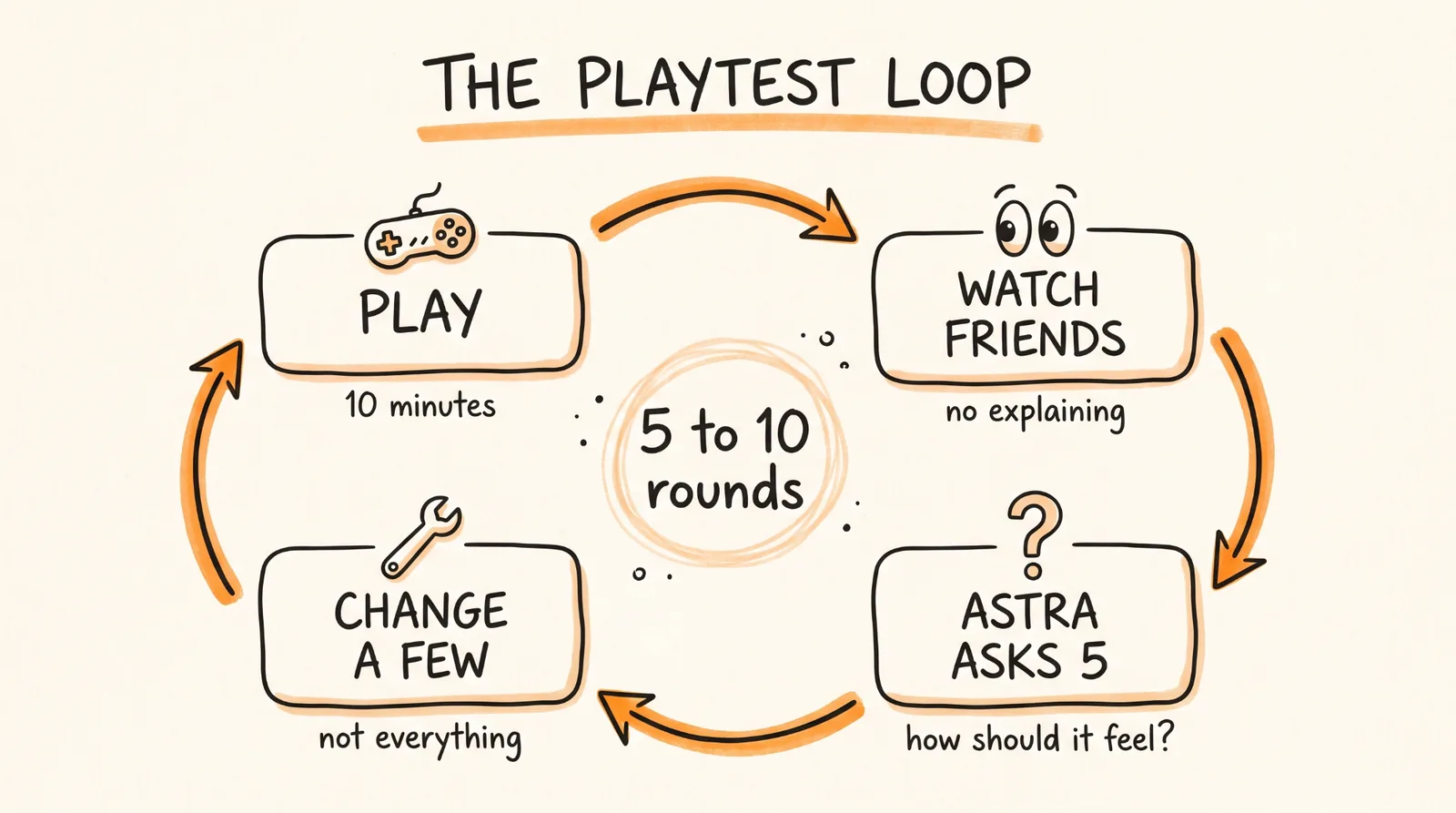
This is where games get good. Play your build for 10 minutes. Then have three friends play it without you explaining anything. Watch where they get confused, where they get bored, and where they say "one more."
Then paste this into the same chat:
I played the build. Here is what I noticed: [WHAT FELT OFF, WHAT WAS BORING, WHAT WAS FUN, WHERE PLAYERS GOT STUCK]
Before you change anything, ask me 5 questions to understand exactly how I want this to feel. Focus on:
1. How the controls should feel (floaty, snappy, heavy, precise)
2. How hard the game should be in the first minute versus the fifth
3. Which moment should feel the most satisfying, and how to make it pop (sound, screen shake, particles, slow motion)
4. What is missing from the art style
5. What would make someone share this with a friend
After my answers, list every change you plan to make, then make them, then give me the new link.
Repeat this loop as many times as it takes. Most good games take five to ten rounds. Each round, change a few things, not everything. If you change twenty things at once, you will not know which one made it better or worse.
The details that make browser games feel good are almost always the same: instant restart, a satisfying sound on every action, a little screen shake on big moments, a score that climbs fast early, and a round short enough to "just play one more."
Step 7: Deploy, Multiplayer, and Publish (Prompt 4)
When the game feels right, paste this:
Deploy the final version of this game on Higgsfield Supercomputer so it runs from a shareable browser link.
Turn on multiplayer with:
- A lobby where players can create or join a room with a short code
- [NUMBER] players per room
- State sync so every player sees the same positions, scores, and events
- A simple fallback so the game is still playable solo if nobody else joins
Then give me the live link, a one-paragraph game description, and three title ideas.
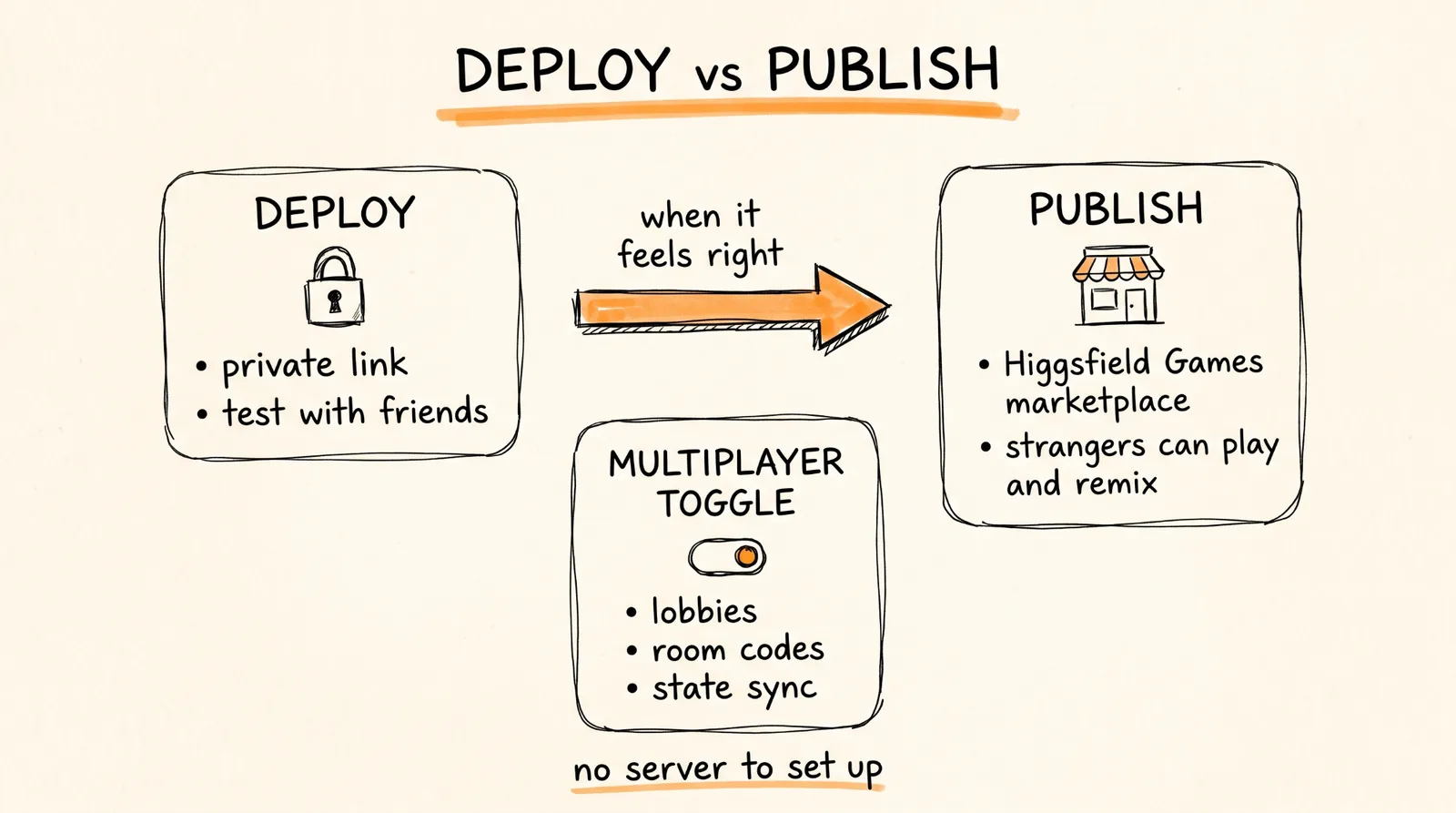
Higgsfield handles the hosting, the build, the lobbies, and the state sync. You do not set up a server.
Deploying and publishing are two different things. Deploying gives you a private link anyone you send it to can play. Publishing puts the game in the Higgsfield Games marketplace, where strangers can find it, play it, and remix it with their own prompts. Test with your private link first, then publish once you are happy.
Step 8: Make Money From It
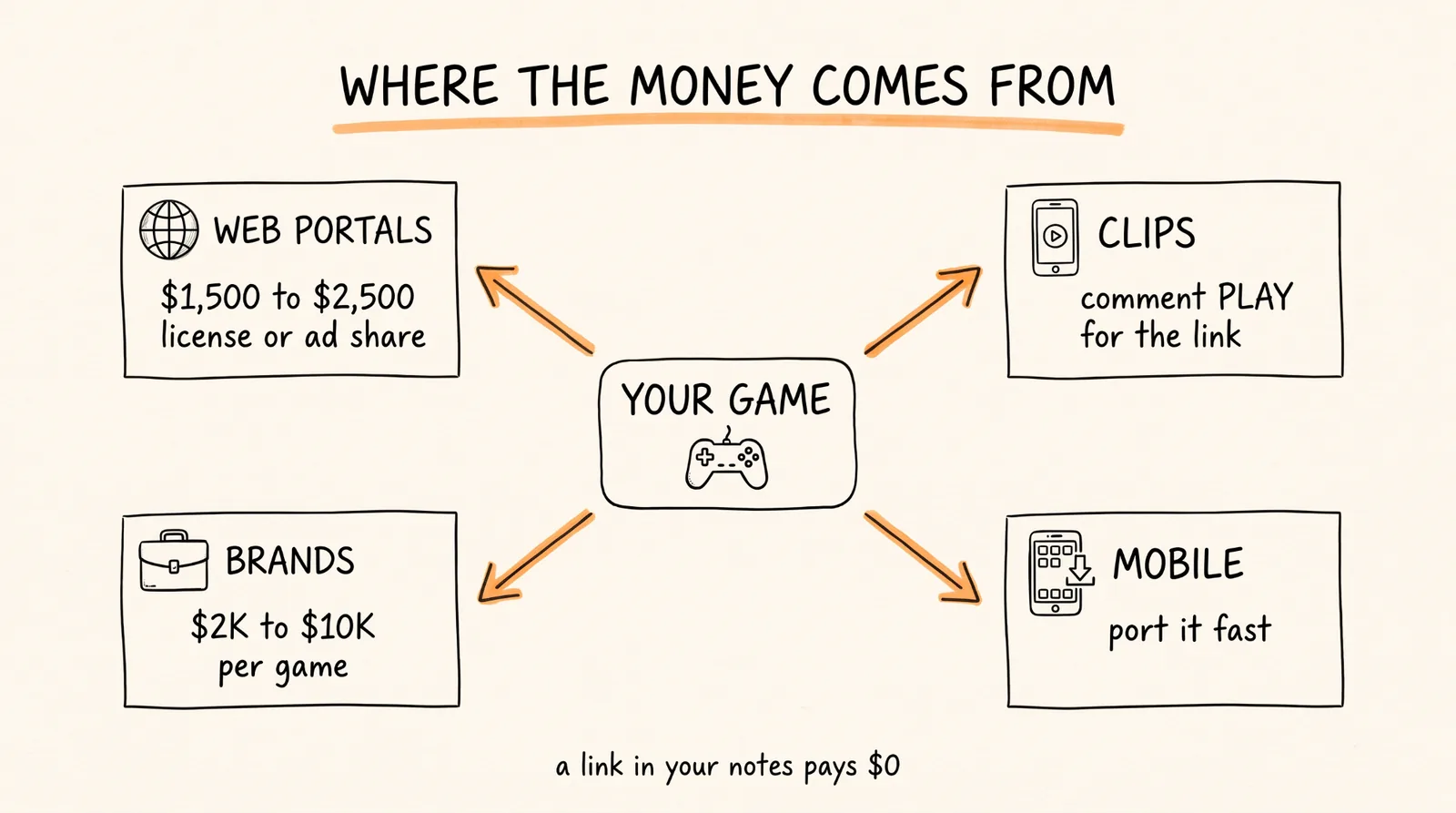
A link alone does not pay you. Here is where the $25K came from, and how to copy it.
Web game portals. Coolmath Games, Poki, CrazyGames, GameDistribution, and GamePix all need a steady flow of new games and pay developers for them. There are two deals. Ad revenue share, where you add the portal's SDK, they show ads in your game, and you split the money. Or a license fee, where the portal pays you once, usually $1,500 to $2,500 for a solid casual game, and keeps the revenue. You can do both across different portals.
To submit, go to each portal's developer page, create an account, and upload your build. Portals want a standalone build they can host, so this is where the advanced route from Step 5 pays off. Before you sell a license, read Higgsfield's terms on commercial use and exporting, and ask Astra to package the game as a standalone HTML5 build.
Your own audience. Post a 10-second clip of the most satisfying moment in the game on TikTok, Reels, and Shorts with "comment PLAY for the link." A browser link means zero friction. They tap and they are playing.
Build games for businesses. Brands pay for playable ads and branded mini-games. A restaurant chain wants a simple game with their mascot for a promo. A school wants a learning game. A small studio can charge $2,000 to $10,000 for a branded browser game, and with this workflow it is a week of work.
Mobile. The developer behind the $25K game said he left another $40,000 to $50,000 on the table by not moving fast enough on a mobile version. If a web version takes off, port it with a mobile publisher quickly.
When Things Go Wrong
The first build is nothing like what you pictured. Your brief was too vague. Go back to Prompt 1, answer the 10 questions in more detail, and give Astra a reference game.
Assets do not match each other. Name one art style, one color palette, and one reference game in the asset prompt, and ask Higgsfield to generate everything in the same session.
The game lags on phones. Ask Astra to reduce polygon counts, compress textures, and cap the frame rate on mobile. Low-poly is a style, not a compromise.
Multiplayer feels out of sync. Keep rooms small, four to eight players, and ask Astra to reduce how much game state it syncs every frame.
Your credits ran out mid-build. Generate the core assets first and placeholders for the rest. Swap in final art once the gameplay is locked.
You change one thing and something else breaks. Ask Astra to list everything it changed after every round, and tell it to fix one problem at a time.
A portal rejected your game. The most common reasons are poor mobile controls, long load times, and games too similar to one they already host. Fix the controls, cut the load time, and push your version's twist harder.
Rules to Remember
Copy a trend, not a game. Build the better version of what is already working.
Let Astra interview you first. A good brief saves a week of rebuilding.
Get the core loop fun before you add anything else.
Playtest with people who have never seen it, and watch without explaining.
Change a few things per round, not everything.
Deploy privately, test, then publish.
The money is in distribution. Portals, clips, and brands pay. A link sitting in your notes does not.
You now have a system that turns a one-sentence idea into a playable multiplayer 3D game with a live link, plus the exact playbook that turned one AI-built game into 60 million players.
Don't want to figure this out alone? I walk members through every step inside the community. Join the Skool → skool.com/raycfu