
How to Build a Claude Code Agent That Finds Clients While You Sleep
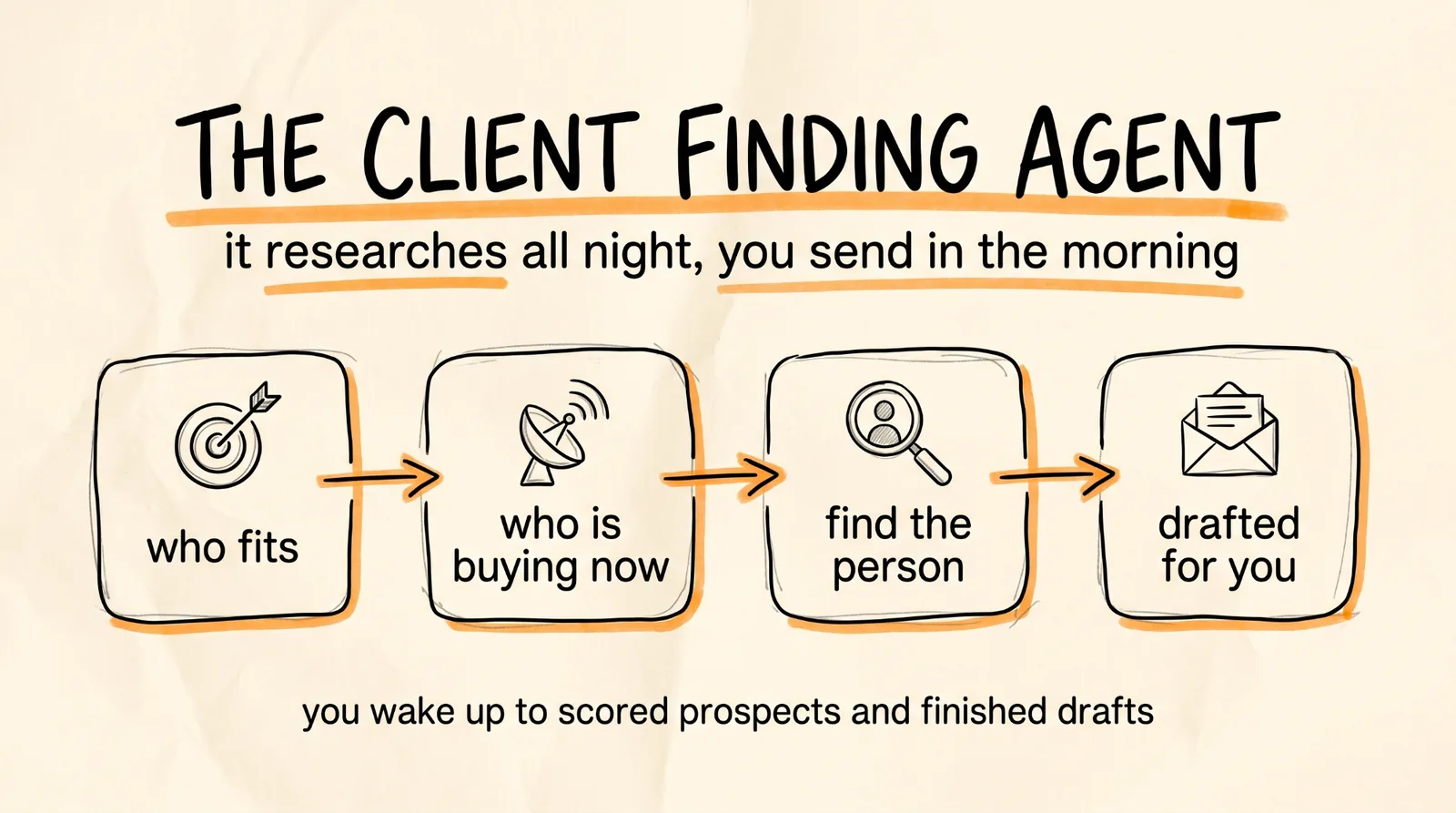
This is the full guide from the video. You are going to build a pipeline in Claude Code that defines who your best clients actually are, finds companies matching that profile, watches for the signals that mean they are buying right now, enriches each one with a verified decision-maker, and hands you scored prospects with drafted emails every morning at 7am.
Don't want to figure this out alone? I walk members through every step inside the community. Join the Skool → skool.com/raycfu
What You Need
Claude Code, and an Apollo account on any paid plan, which is what gives you the contact database, the enrichment, and the verified emails. Apollo ships an official MCP server plus a Claude Code plugin, so this connects properly rather than through a scraper.
For sending, an inbox rotation tool like Instantly, so volume is spread across multiple mailboxes instead of hammering your main domain.
One correction before you start, because it will save you an account. There is no official LinkedIn MCP, and LinkedIn's user agreement explicitly prohibits scraping and automated access. The community LinkedIn MCP servers work by driving your logged-in session, which puts your real account at risk of being restricted. You do not need one anyway, Apollo's people search covers the same prospecting from a licensed database. If you want deeper sourcing later, Clay and Derrick are the compliant options.
Step 1: Build the ICP Agent
Everything downstream is only as good as this. Most people describe their ideal client from memory and get a vague profile that matches half the internet. Instead, give the agent your actual past clients and have it reverse engineer the pattern.
Paste this into Claude Code:
You are my ICP researcher. I am going to give you my past clients and you are going to reverse engineer what they have in common.
Here are the clients: [LIST THEM: company name, what they do, roughly what size, what they hired me for, and how the engagement went]
Research each one and find the pattern across: industry and sub-industry, company size in headcount and revenue band, funding stage, the tech stack they run, who inside the company was the buyer, what problem they hired me to solve, and what was happening at the company at the moment they bought.
Then produce two things.
First, my ideal customer profile as a set of filters I could actually search on, not adjectives. Headcount ranges, specific industries, named technologies, funding stages.
Second, my anti-profile: the characteristics my worst-fit clients shared, so we can exclude them.
Separate what you found in the data from what you are inferring, and tell me which parts of this are based on too few examples to trust yet. Save it as icp.md.
That last instruction is the one that keeps you honest. With four past clients, some of what looks like a pattern is coincidence, and an agent that flags that is more useful than one that confidently invents a profile.
Step 2: Add the Buying Signals
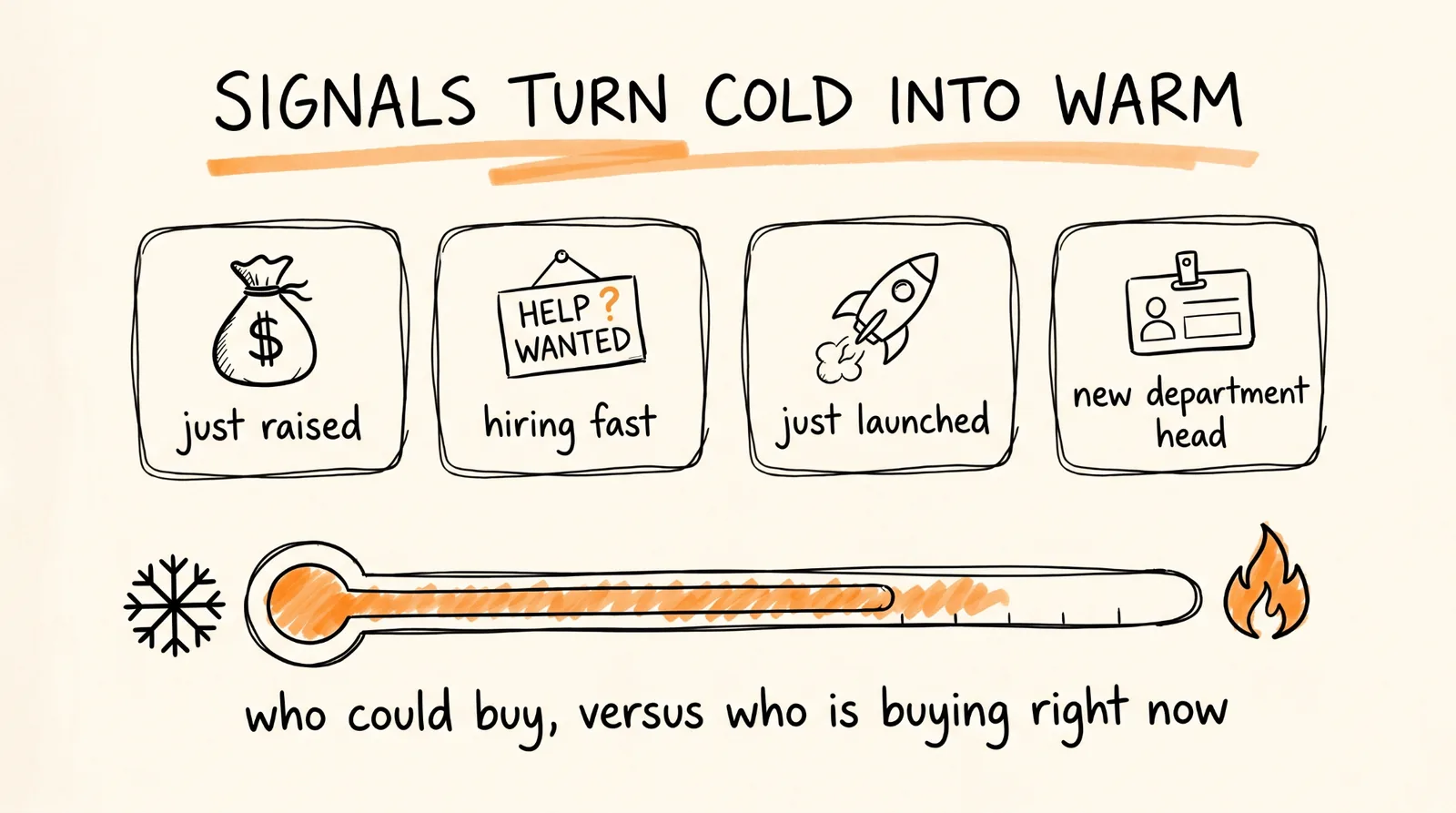
An ICP tells you who could buy. Signals tell you who is buying now, and that is the difference between cold outreach and warm outreach.
The logic is simple. A company that just closed a funding round has budget it is under pressure to deploy. A company that just posted three engineering roles has more work than people, which is the exact condition that makes them hire outside help. A company that just launched a product needs it to land. A company that just hired a new head of a department is watching that person look for quick wins.
Add this to your ICP file:
Add a buying signals section to icp.md. For my specific service, list the observable events that indicate a company is likely in-market right now, and for each one: what the signal is, where it can be observed, how long it stays relevant after it happens, and how strongly it predicts a purchase for what I sell.
Rank them by how strong the signal is. Be honest about which ones are weak, a company doing something once is not always a signal.
Be careful with the multiplier claims you see repeated online about funding and buying intent. The direction is right and it is common sense, budget follows funding. The precise numbers people quote are usually unsourced, so use the logic in your outreach rather than a statistic you cannot back up if a prospect asks.
Step 3: Wire Up the Data Agent
Now connect the data. Apollo has an official MCP server and an official plugin for Claude Code, which bundles ready-made workflow commands. Install the plugin from Apollo's repo and you get commands like /apollo:prospect and /apollo:enrich-lead.
Then the research agent prompt:
You are my prospecting agent. You research and score. You never contact anyone.
Read icp.md before every run.
Every run: search Apollo for companies matching my ICP filters. Exclude anything matching my anti-profile, and exclude any company already in prospects.md.
For each company that matches, check for the buying signals in icp.md and record which ones are present and when they happened.
Then find the most likely decision-maker for what I sell and enrich them with a verified email. If Apollo cannot verify the email, mark it UNVERIFIED and do not include it in the send list.
Score every prospect from 1 to 100 on how closely they resemble my best past clients, and show your reasoning in one line. Signal strength and recency should move the score.
Give me the top 20 as a table sorted by score, with company, decision-maker, title, verified email, the signals you found, the score, and the one-line reason. Append everything to prospects.md so nobody gets researched twice.
Two things in there matter more than the rest. The UNVERIFIED rule, because sending to unverified addresses is what gets your domain flagged as a spammer, and the deduplication file, because nothing kills a reply rate like contacting the same person three times from different angles.
Step 4: Put It on a Schedule
Set the pipeline to run every weekday morning at 7am, so your prospects are waiting with your coffee.
Schedule the prospecting agent to run every weekday at 7am. Each run: read icp.md, search for new companies, check buying signals, enrich decision-makers with verified emails, score everything, and write the top 20 to a dated file in prospects/.
If a run returns fewer than 5 qualified prospects, do not pad the list. Tell me the ICP filters may be too narrow, or the market segment is exhausted, and stop.
Notify me when the file is ready.
That no-padding rule is worth keeping. An agent that must produce 20 rows will start including companies that do not fit, and a list you cannot trust is worse than a short list you can.
Step 5: The Email Agent, and Why You Still Hit Send
Now the outreach. Two parts: writing the emails, and sending them without burning your domain.
The writing prompt:
You are my outreach writer. You draft emails. You never send them.
For each prospect in today's file, write one cold email. Rules: under 100 words. Reference the specific signal you found, the funding round, the job postings, the launch, so it is obvious this is not a blast. No compliments about their company, no marketing language, no "I hope this finds you well."
One clear ask, and make it small: a reply, not a 30-minute call.
Never invent a fact about their business. If the only thing you know is the signal, that is enough, write around it.
Include a plain unsubscribe line and my business mailing address at the bottom.
Give me all 20 drafts in one document for review.
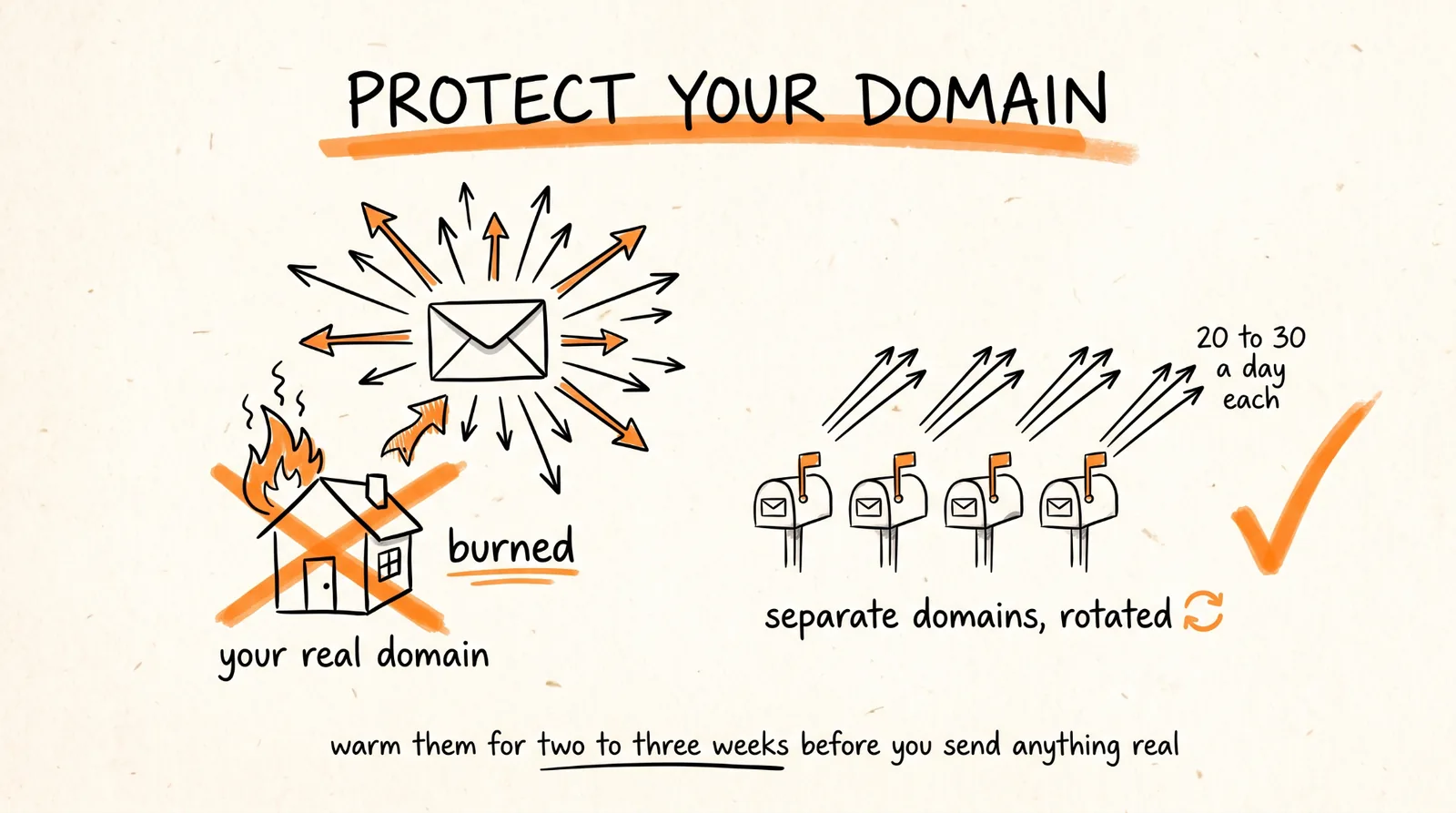
On sending, the domain point from your video is the important part. Never send volume from your primary domain, because if it gets flagged, your actual business email stops arriving. Buy separate lookalike domains, set up SPF, DKIM, and DMARC on each, warm each mailbox for two to three weeks before real sends, and cap each one at roughly 20 to 30 emails a day. A tool like Instantly rotates across those mailboxes so no single one carries the load.
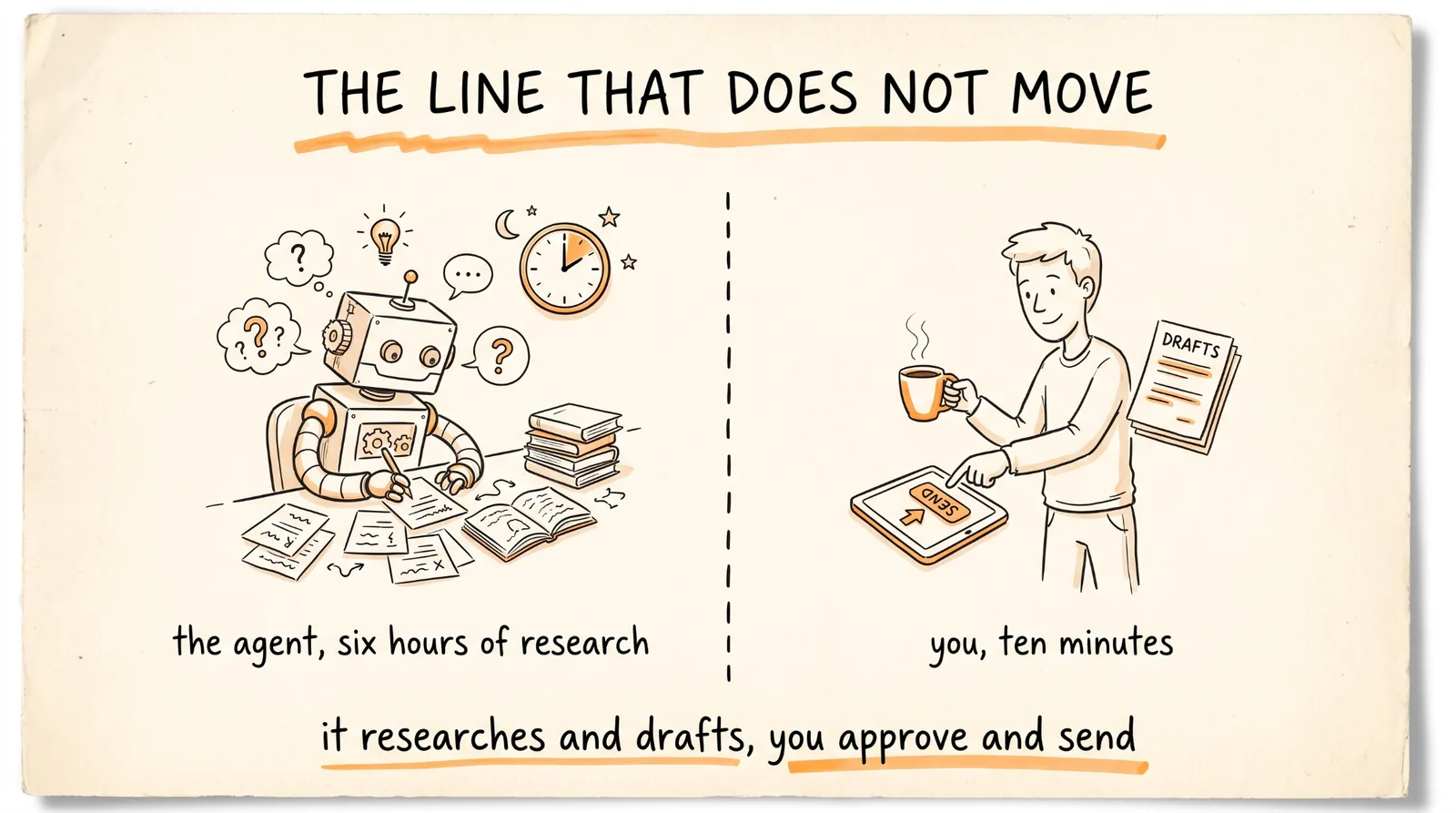
And here is why the agent drafts but you send. Every agent in this pipeline can be wrong in ways you would catch in ten seconds and a machine would not, a signal misread, a name on the wrong company, a claim that does not hold. Ten minutes of reading before you hit send is what stands between a warm pipeline and a burned domain plus an inbox full of angry replies. The agent does the six hours of research. You do the ten minutes that makes it work.
The Legal Part, in Plain English
Automated cold outreach is legal and it has rules. Skipping them is how people end up with a real problem instead of a slow month.
In the US, CAN-SPAM requires accurate headers and sender identity, a subject line that is not deceptive, a working opt-out, and your physical mailing address in the message. Honor an unsubscribe within 10 business days.
If you are emailing anyone in the EU or the UK, GDPR applies and you need a lawful basis. For B2B prospecting, legitimate interest is usually defensible if you are contacting a business address about something genuinely relevant to their job, you say where you got their details, and opting out is easy.
Do not scrape LinkedIn. Use licensed data. It is the same reason the guide routes around the community LinkedIn MCPs.
The Rules That Make This Work
Score by resemblance to your best past clients, not your loudest intuitions.
Never send to an unverified address. UNVERIFIED means it stays off the list.
Deduplicate ruthlessly, one person, one sequence, ever.
Ten personal emails a day beats a hundred blasts, every time, and it keeps your domains alive.
The agent researches and drafts. You approve and send. That line does not move.
The Recap
Feed your past clients to an ICP agent and let it reverse engineer the pattern into searchable filters plus an anti-profile. Add buying signals so you are contacting people who are in-market now. Connect Apollo through its official MCP so the data is licensed and the emails are verified. Schedule the whole thing for 7am. Then read the drafts over coffee and send the good ones yourself.
Don't want to figure this out alone? I walk members through every step inside the community. Join the Skool → skool.com/raycfu