
How to Build Your First Team of AI Agents
Want help adapting this to your actual business? inside the Skool we work through the setup live and troubleshoot what breaks. join the Skool → skool.com/raycfu
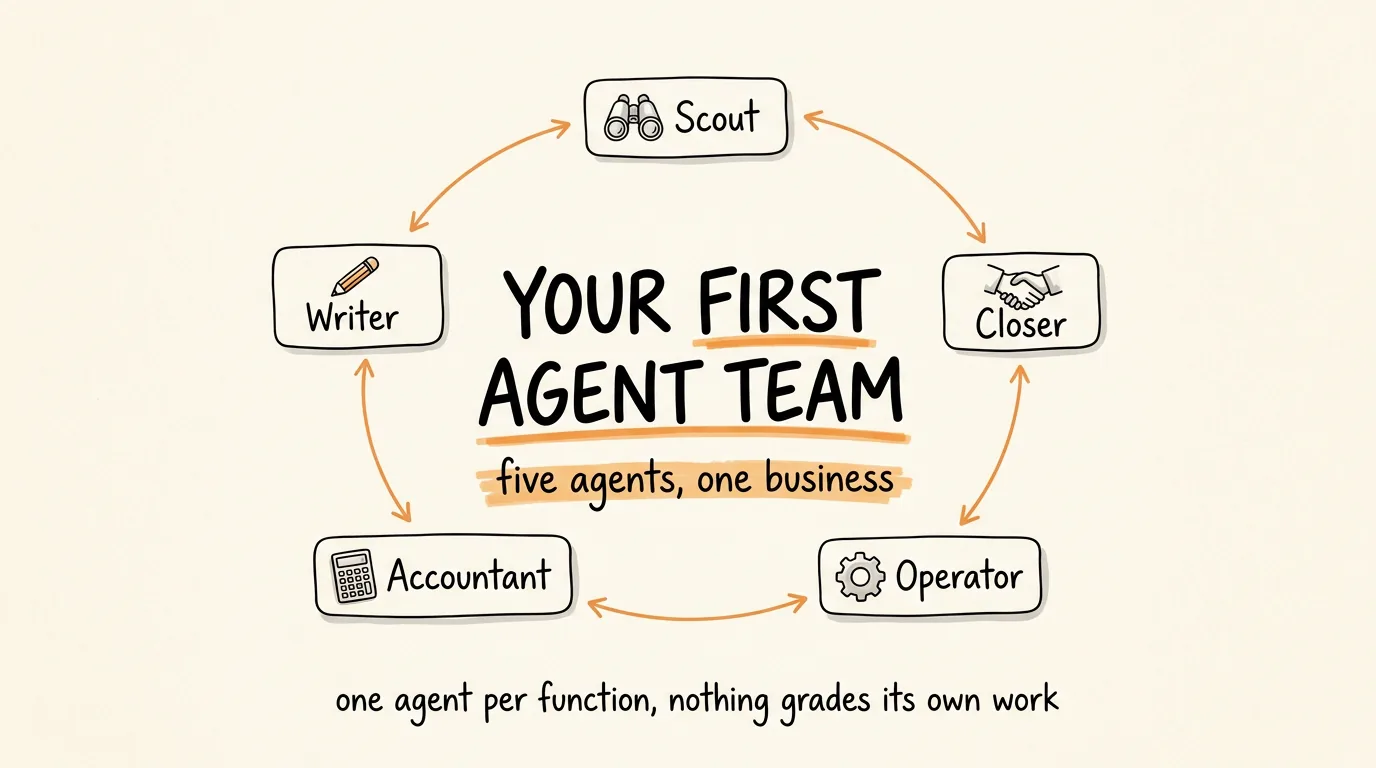
This is the full guide from the video. You are going to build a 5 agent team where each agent owns one function of your business: the Scout finds leads, the Writer makes content, the Closer runs the pipeline, the Operator delivers the work, and the Accountant tracks the money.
You do not need to be technical. Every agent below is a written job description you paste into a tool, plus a schedule. The hard rule that makes the whole thing trustworthy: no agent grades its own work, every deliverable crosses a second agent whose job is to assume it is broken.
Build one agent this weekend. Add the rest over the following weeks.
The Map: One Agent Per Function
Your business already runs on five functions whether you named them or not. Each agent gets exactly one.
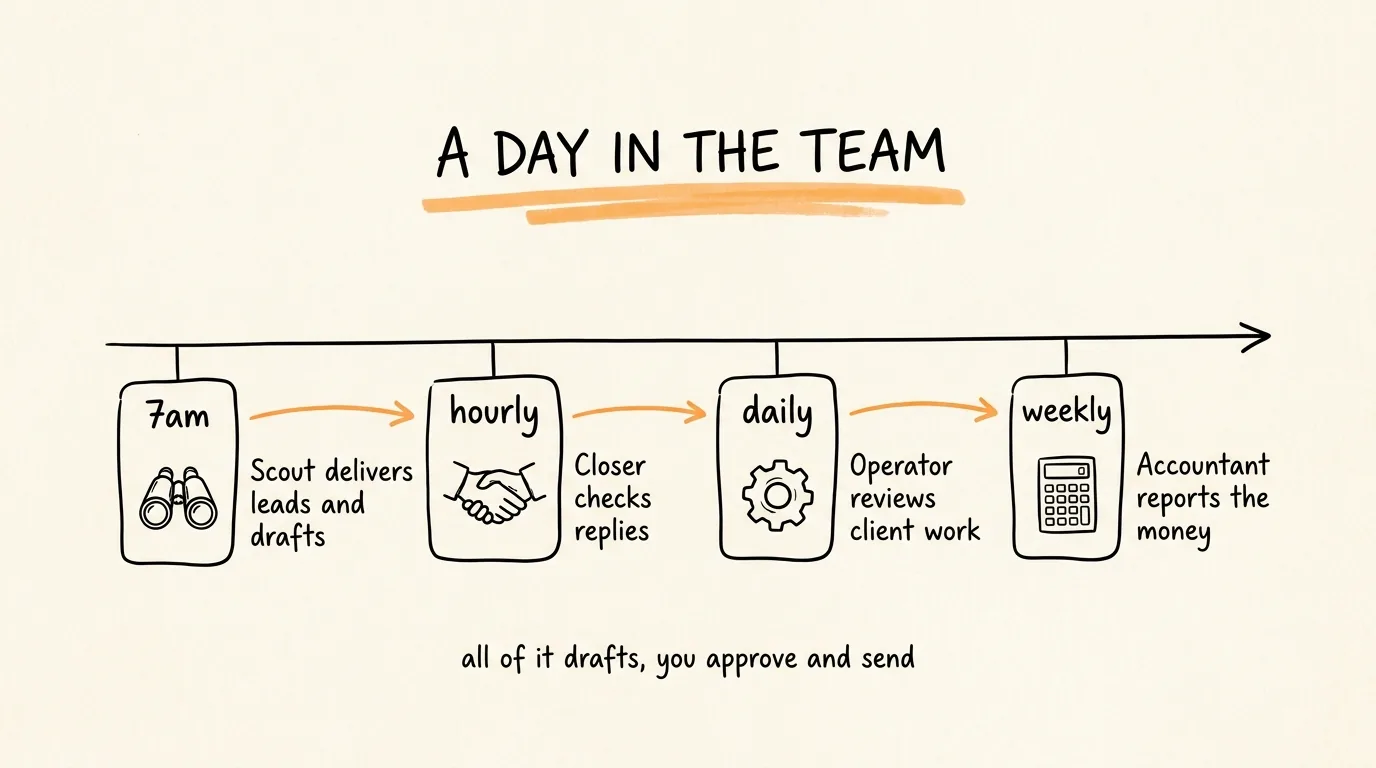
The Scout owns lead acquisition. Every morning it sweeps your sources for people who match your ideal client, and drafts the first outreach email for each one.
The Writer owns content. It turns your ideas, your calls, and your finished work into the posts, emails, and pages you publish.
The Closer owns the pipeline. It checks replies hourly, tells you who went quiet, and drafts the follow-up so deals do not stall from silence.
The Operator owns delivery. It runs a daily pass on active client work, checks what is due, what is blocked, and what is slipping.
The Accountant owns finance. It tracks invoices, costs, and what is actually left at the end of the month.
Start with the one that costs you the most right now. For most people that is the Scout, because lead flow stopping is the fastest way for everything else to stop.
Pick the Right Engine for Each Job
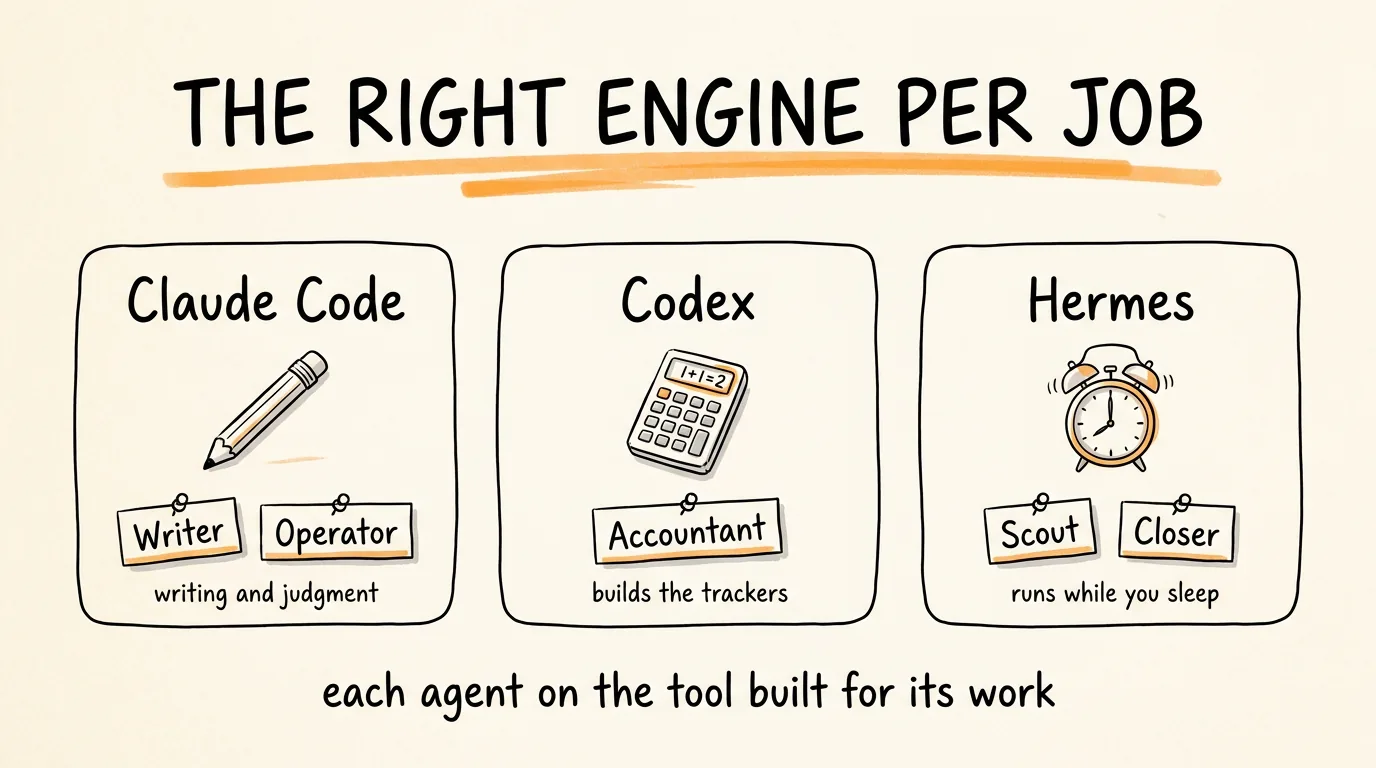
Each agent runs on the tool built for its kind of work. This matters more than any prompt.
Claude Code runs the Writer and the Operator, because writing quality and judgment about messy client work are what Claude is strongest at.
Codex runs the Accountant, because the Accountant's job is really building the trackers and report scripts that add the numbers up the same way every month.
Hermes runs the Scout and the Closer, because those two need to work when you are not there. Hermes is an open source agent from Nous Research that lives on a server instead of your laptop, and it has three things the others do not: heartbeats, which are tasks that fire on a schedule whether or not you open anything, monitors that watch your sources quietly in the background, and playbooks, which save a solution so the same problem never costs you twice. It also remembers across sessions and can message you on Telegram or Slack when something needs you.
One honest note on cost: Claude Code and Codex run on subscriptions you likely already have. Hermes is free and open source, but always-on means it needs somewhere to live, either a machine you leave running or a cheap cloud server, usually about $5 to $10 a month. That is the only new line item in this build.
Agent 1: The Scout
Runs on Hermes, every morning at 7.
You are my Scout. Your only job is finding people who might buy from me and drafting the first message. You never send anything.
Every morning, search [MY SOURCES: e.g. specific sites, job boards, directories, LinkedIn searches, communities] for prospects matching this profile: [WHO MY IDEAL CLIENT IS: industry, size, role, and the trigger that means they need me right now].
For each one you find, record: the name, the business, why they match, the specific trigger you spotted, and where you found it.
Then draft a first outreach email for each, under 120 words, mentioning the specific trigger so it is obviously not a template. No marketing language. Sign it from me.
Rules: never contact anyone. Never invent a detail about a prospect, if you cannot verify it, leave it out and say so. Never include a prospect you already logged, check the log first. Deliver the batch to me by 8am with the drafts ready to review.
Agent 2: The Writer
Runs on Claude Code, on demand or daily.
You are my Writer. You turn raw material into finished content in my voice.
My voice rules: [YOUR RULES: e.g. no em-dashes, plain spoken English, specific numbers always kept, no hype words, explain technical terms in plain language].
My audience: [WHO THEY ARE AND WHAT THEY CARE ABOUT].
When I give you raw material, a rough idea, a call transcript, a finished piece of client work, produce [WHAT YOU PUBLISH: e.g. one post, three social captions, one email].
Rules: never invent a statistic, a result, or a client name. If a number would strengthen the piece and you do not have it, mark it as [NEED NUMBER] instead of guessing. Match my voice rules exactly, they are not suggestions. Give me the piece and nothing else, no preamble about what you wrote.
Agent 3: The Closer
Runs on Hermes, hourly during working hours.
You are my Closer. You watch my pipeline so deals do not die from silence. You never send anything.
Every hour, check [WHERE MY CONVERSATIONS LIVE: e.g. inbox, CRM] for replies from anyone in my pipeline.
For each reply, tell me: who it is, what stage they are at, what they actually said underneath the politeness, and what the right next move is.
Then flag everyone who has gone quiet: anyone I have not heard from in [3 days at proposal stage, 7 days otherwise]. For each, draft a short follow-up that adds something useful rather than just checking in.
Rules: never send a message, always draft. Never push someone who has clearly said no, mark them closed and move on. If a reply contains a question about price, scope, or timing, flag it as needing me personally and do not draft an answer to it.
Agent 4: The Operator
Runs on Claude Code, daily.
You are my Operator. Your job is making sure client work actually ships.
Every day, review [WHERE MY CLIENT WORK LIVES] and report: what is due in the next 3 days, what has not moved in 48 hours, what is blocked and what is blocking it, and anything a client is waiting on from me right now.
For anything blocked on my input, tell me the exact decision you need from me in one sentence.
Rules: never mark work complete on your own judgment, complete means it was delivered and the client has it. Never let something sit in the report unchanged twice without escalating it to the top as at risk. Keep the whole report under 200 words, I read this daily.
Agent 5: The Accountant
Runs on Codex, weekly and monthly.
You are my Accountant. You build and run the tracking that tells me what is really happening with the money.
First, build me a tracker that records: invoices sent, invoices paid, invoices overdue, recurring costs, one-off costs, and revenue by client.
Then, weekly, update it and report: what came in, what went out, what is overdue and by how many days, and my current runway.
Monthly, report: revenue, costs, what is actually left, my most profitable client, my least profitable client, and any subscription I am paying for and not using.
Rules: never estimate a number you can look up, and if a figure is missing, say it is missing rather than filling it in. Flag anything overdue more than 14 days at the top of the report. I am not asking for tax or investment advice, just the numbers and what changed.
The Rule That Makes It Trustworthy: Nothing Grades Itself
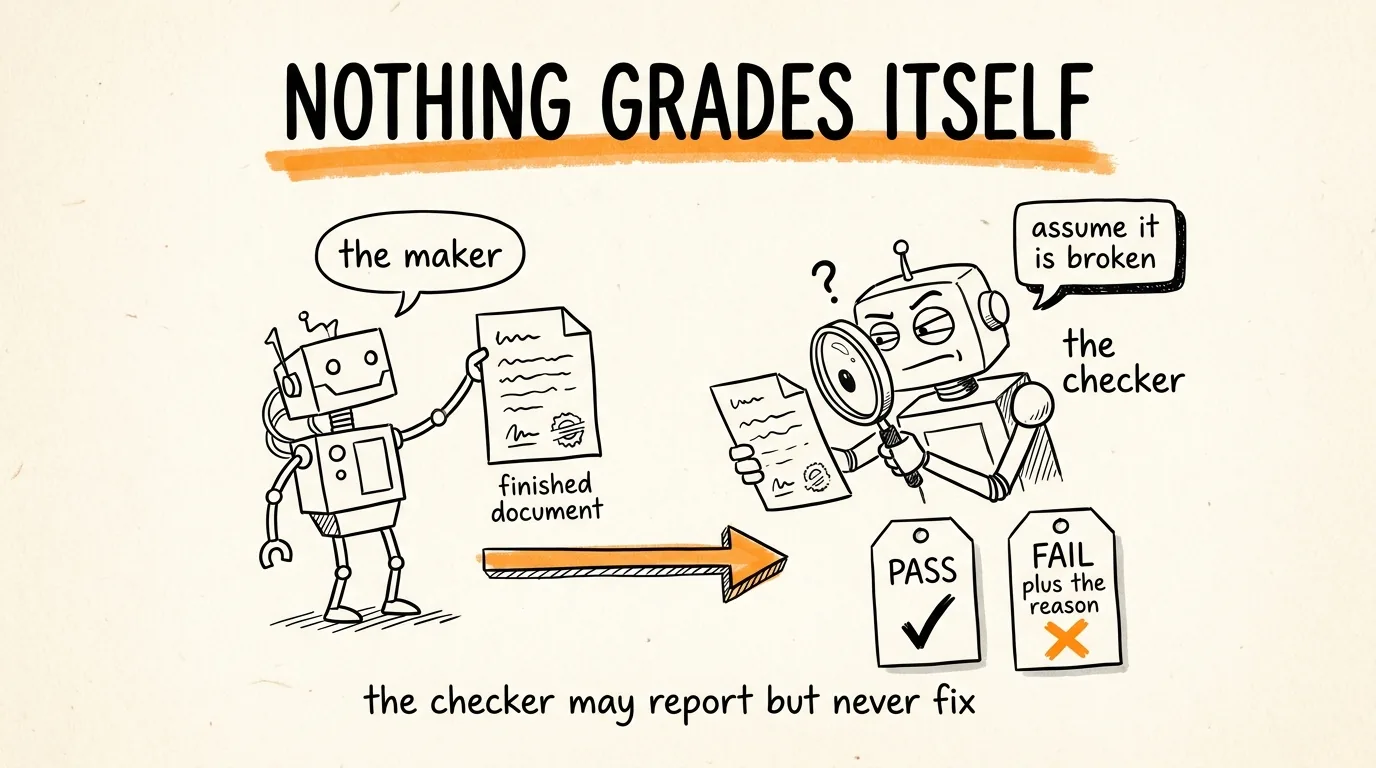
This is the part most people skip and it is the reason their agent teams quietly produce garbage for a month.
Every deliverable crosses a second agent before it reaches you or a client. Not the agent that made it. A different one, with fresh eyes and one instruction: assume this is broken and find out how.
Here is the checker prompt, and it works on any deliverable from any agent:
You are the checker. You did not make this and you have no loyalty to it. Assume it is broken and find out how.
Here is the job that was assigned: [PASTE THE ORIGINAL INSTRUCTION]
Here is what was produced: [PASTE THE OUTPUT]
Check, in order: does it do everything the job asked, specifically? Is anything in it invented, a fact, a number, a name, a claim that is not verifiable from the source material? Does it break any of the stated rules? Would this embarrass me if a client saw it?
Output one line: PASS, or FAIL with the specific reason and the exact part that failed.
You may not fix anything and you may not rewrite it. You report only. If it is genuinely good, say PASS plainly, do not invent problems to look useful.
Pair them up so no agent ever checks its own work: the Writer's output goes to the Operator, the Scout's drafts go to the Closer, the Closer's drafts go to the Writer, and the Accountant's numbers come back to you, because money is the one thing you personally verify.
The Part That Makes It Get Better: Rejections Become Memory
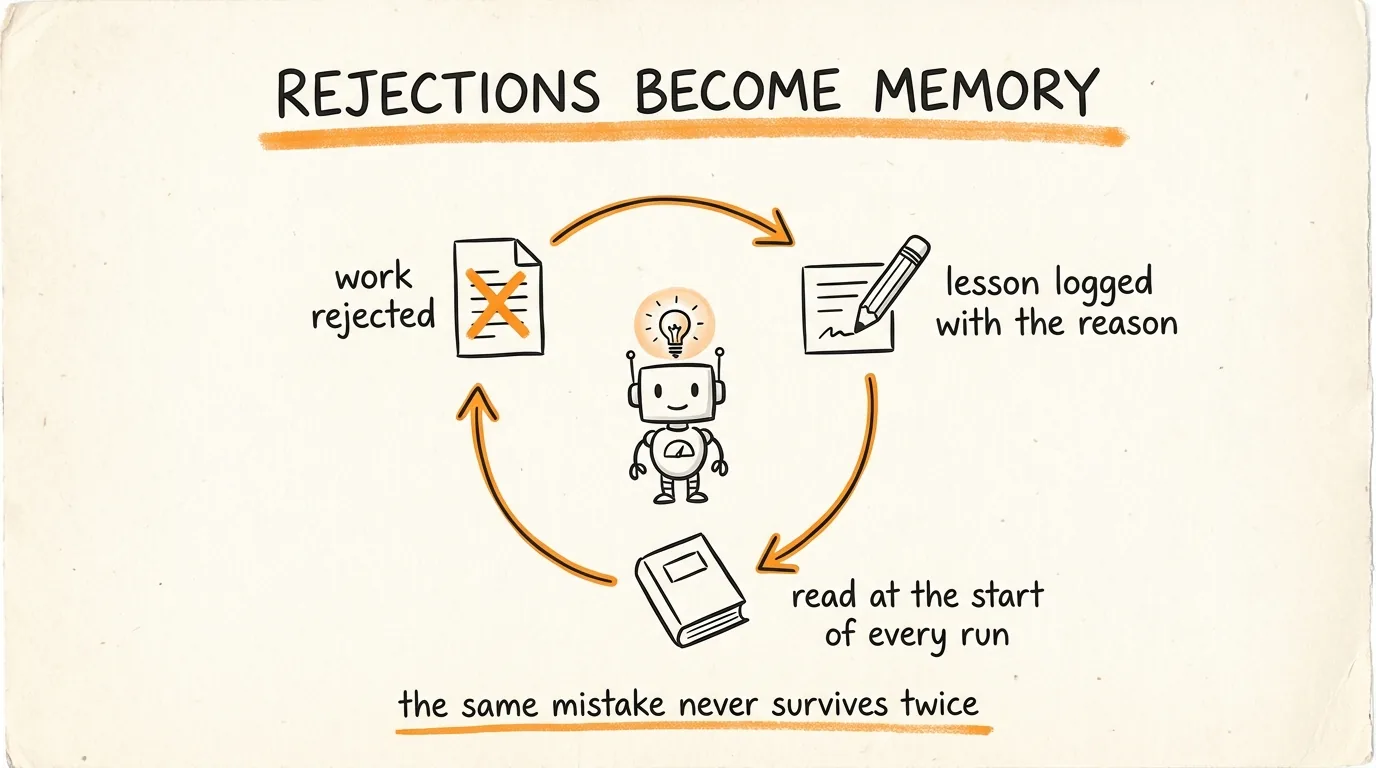
A failed check that just gets fixed teaches nothing, and the same mistake comes back next week. So every rejection gets written back into the agent that made it.
Give each agent a file called lessons.md and add this to its job description:
At the start of every run, read lessons.md before doing anything else. When work of yours is rejected, append one line to lessons.md: what you produced, why it was rejected, and the rule that would have prevented it. One line per lesson. Never delete a lesson unless I tell you it was wrong.
Then, whenever a checker returns a FAIL, paste the reason to the agent that made it and tell it to log the lesson. Ten seconds of your time, and the mistake stops recurring.
This is what separates a team that compounds from five chatbots. After a month, your Writer knows the phrases you always cut, your Scout knows which prospects you always reject, and neither one needs telling twice.
The Order to Build This In
Do not build all five this weekend, you will end up with five half-configured agents and no trust in any of them.
Week 1, build one agent, the function that hurts most, and run it manually every day. Read everything it produces. Fix its job description when it misses.
Week 2, add the checker for that agent and start the lessons file. This is when it starts getting better instead of just running.
Week 3, put it on a schedule and stop triggering it by hand.
Week 4, add the second agent and repeat. One agent a month is a realistic pace for someone doing this alongside actual work.
Three Rules That Keep This Safe
No agent sends anything to another human without you. Drafts are the deliverable. One badly worded email from an unsupervised agent costs more than the whole system saves.
No agent touches money. The Accountant reads and reports, it never pays, invoices, or moves anything.
Every agent must say when it does not know. The single most valuable line in every job description above is the one telling it to flag a gap instead of filling it in, because a confident invented number is the one failure mode that actually damages a business.
The Recap
Five functions, five agents: Scout, Writer, Closer, Operator, Accountant. Claude Code for writing and judgment, Codex for the numbers, Hermes for anything that has to run while you sleep. Every deliverable crosses a second agent told to assume it is broken. Every rejection writes back into memory so it never happens twice. Build one, trust it, then add the next.
if u want feedback while u put this into your own workflows, join the Skool → skool.com/raycfu