
6 GitHub Repos That Make You Money with AI
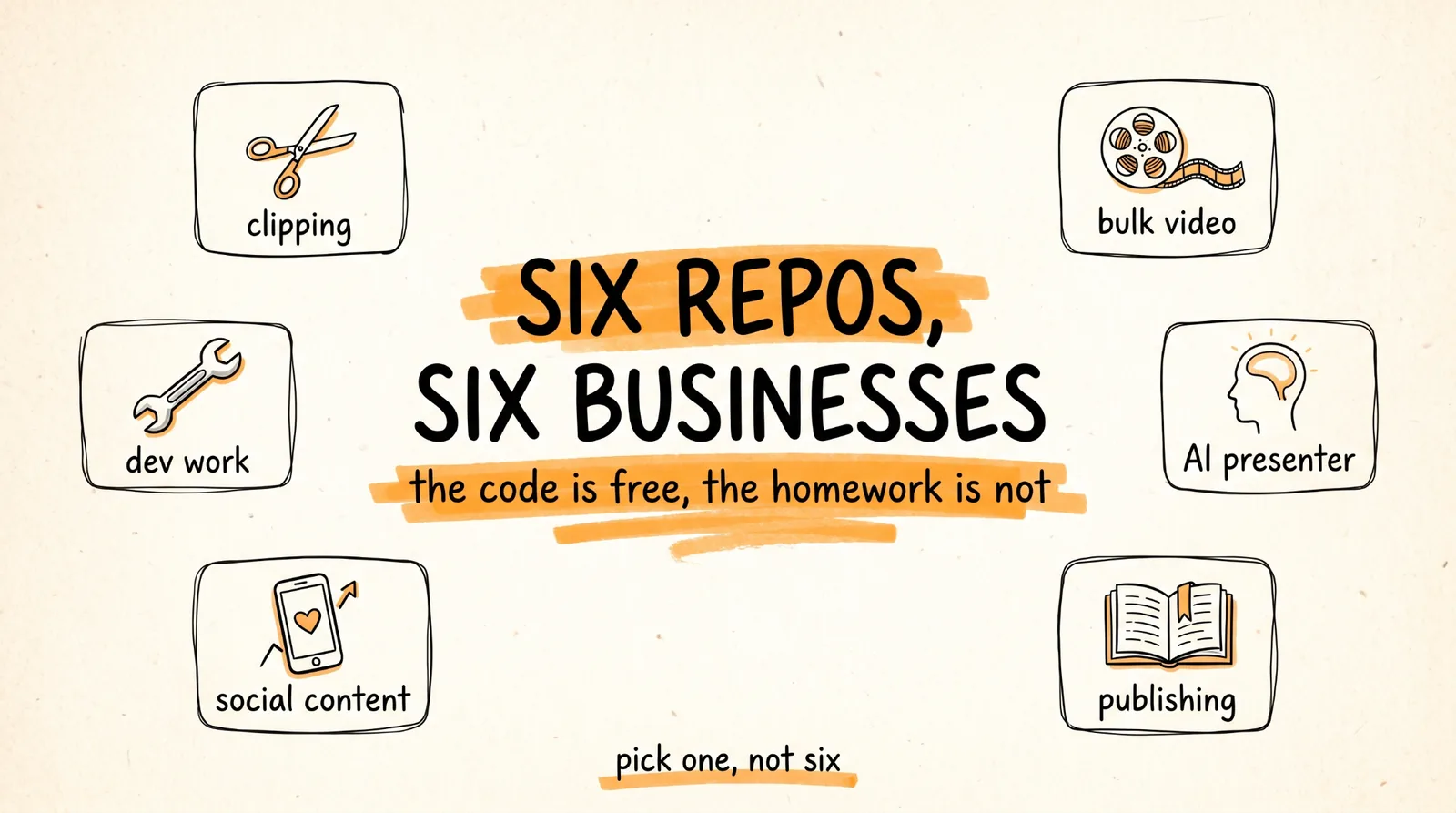
This is the full guide from the video. Six free repos, what each one actually does, the business you can build on it, and the specific thing that will bite you if you skip it.
Don't want to figure this out alone? I walk members through every step inside the community. Join the Skool → skool.com/raycfu
1. autoclip_mvp, the Clipping Service
github.com/zhouxiaoka/autoclip_mvp
It takes long-form video and automatically finds the highlights, then cuts them into short clips. Podcasters, YouTubers, and course creators all sit on hundreds of hours of footage they know contains good short-form content, and none of them have time to go find it.
The business: clipping as a service. Charge monthly per creator, deliver a batch of clips every week from whatever they published. This is a real, currently well-paid service business, and the reason it works is that the raw material already exists, you are just extracting it.
Where to sell it: podcasters with a back catalogue, anyone running a YouTube channel over 20 minutes an episode, and course creators who want promotional clips from lessons they already recorded.
The thing to know: automatic highlight detection finds moments that look interesting to a model, not moments that will actually perform. Treat its output as a shortlist, not a delivery. The value you add is picking the 5 that will work from the 30 it surfaced, and if you skip that step you are selling volume nobody watches.
2. Remotion, Programmatic Video at Scale
github.com/remotion-dev/remotion
Videos built from React code, which means you can generate hundreds of personalized or templated videos from a spreadsheet. Real estate listing videos, personalized outreach, data-driven social content, automated report videos.
The business: high-volume video production nobody can do by hand. Companies like Submagic and Crayo built real revenue on this exact foundation.
Now the part that matters, and it is the single most important thing in this guide.
Remotion is not MIT licensed. It is source-available with a company-size threshold, and the terms are specific. Individuals, non-profits, and for-profit teams of 3 or fewer people can use it commercially for free, and that free tier is a genuine commercial license, not a trial. A solo operator can ship paid client work on it and owe nothing. But once a for-profit organization has 4 or more people, it needs a paid Company License, which starts at $100 a month.
There are two more traps in the details. If you build an automated video product, a video editor, a prompt-to-video app, or anything that renders in bulk for users, that falls under Remotion for Automators, which is $0.01 per render with a $100 monthly minimum, regardless of your headcount. And on client work, how you deliver changes everything: if you hand over only finished MP4s and the client never touches Remotion, only your headcount counts. If the client owns or runs the Remotion project, both companies' headcounts aggregate toward that 4-person threshold.
So the video's pitch, selling this to media companies and marketing firms, is exactly the case where you need to read the license first. Deliver finished files and you are probably fine as a solo operator. Build them a codebase they own and somebody owes for a Company License. If you want no threshold at all, Motion Canvas is MIT and HyperFrames is Apache 2.0.
3. OpenHands, the Autonomous Developer
github.com/OpenHands/OpenHands
An AI software developer that reads a repository, fixes bugs, and writes features from a text description. It does the work rather than suggesting it.
The business: development services for small businesses that need software but cannot afford a developer. Internal tools, integrations, small applications, maintenance on things that already exist.
The thing to know: this is the most honest of the six about what it requires from you. An autonomous developer producing code you cannot read is a liability the moment a client depends on it, because you are the one they call when it breaks at 11pm. If you can review what it writes, this is genuine leverage. If you cannot, you are selling something you cannot support, and the first serious bug ends the relationship.
Start with narrow, low-stakes work where the requirements are clear and the failure mode is visible.
4. PersonaLive, Real-Time Portrait Animation
github.com/GVCLab/PersonaLive
It animates a portrait image in real time, which is what makes an AI avatar that can run a live stream without a person being there.
The business: AI presenters, always-on streams, virtual hosts for brands that want a consistent face without booking talent.
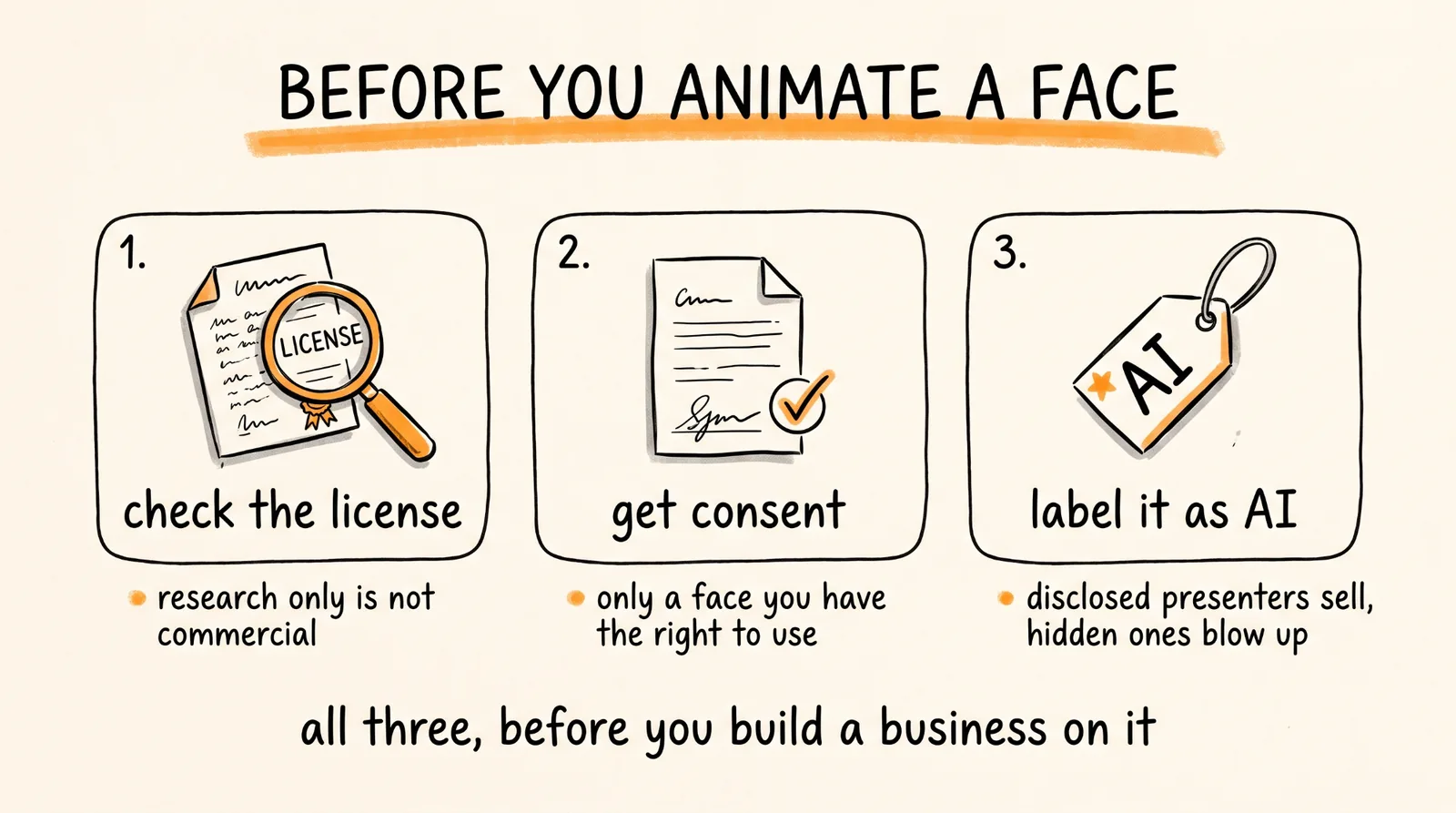
Three things to sort out before you build a business on this, and they are all real.
Check the license yourself. Many portrait-animation models come out of academic labs under research-only or non-commercial licenses, and a research license does not become a commercial one because your use case is commercial. Open the LICENSE file, and if it is restricted, either license it properly or use something permissive.
Only animate a face you have the right to animate. A generated face you own, or a real person with written consent covering this specific use. Animating someone's likeness without permission is the fastest legal problem in this entire guide, and jurisdictions have been actively legislating on it.
Disclose it. Platforms increasingly require realistic synthetic media to be labeled, and an unlabeled AI presenter is both a policy violation and the kind of thing that destroys audience trust the moment it comes out. Disclosed AI presenters are a real product, plenty of brands want one. Undisclosed ones are a liability.
5. RedInk, Content for Xiaohongshu
github.com/HisMax/RedInk
Fast text and image generation formatted specifically for Xiaohongshu, also called RedNote, which is one of the largest social platforms in China.
The business: content production for brands trying to reach Chinese-speaking consumers, which is a genuinely underserved niche because almost nobody in the Western creator economy can operate there.
Two honest cautions. Check the platform's current rules on automated and bulk-generated content before you build a service on it, because every major platform has tightened on this and the penalty is usually account-level. And be realistic about access: operating on Chinese platforms often requires local phone verification and other friction, so validate that you can actually run an account at all before you promise a client results.
Of the six, this is the one where the gap between "the repo works" and "you have a business" is widest. The technical part is the easy part.
6. MuMuAINovel, Mass Book Writing
github.com/xiamuceer-j/MuMuAINovel
An AI assistant for writing books, plots, and novels at volume, aimed at selling on publishing platforms like Amazon KDP.
Here is what you need to know before you write a word, because Amazon has been building specifically against this.
Disclosure is mandatory. KDP asks at publish time whether the book contains AI-generated content, covering text, images including cover art, and translations. AI-generated means the AI created it from your prompts. AI-assisted, meaning brainstorming or grammar checking on your own writing, does not require disclosure. Amazon has stated the disclosure is internal, is not shown to readers, and does not affect ranking or royalties. So it costs you nothing and hiding it is pure downside.
There is a hard volume cap. Standard accounts can publish 3 new titles per day, a limit introduced explicitly to stop mass AI publishing. "Mass writing books" runs directly into a rule built to prevent exactly that.
And enforcement went account-level in 2026. Amazon detects using writing patterns, metadata, and submission velocity, and escalated in April 2026 from removing individual books to suspending accounts. A termination takes your entire catalogue with it and is reportedly hard to appeal. Note that submission velocity is itself a detection signal, so the volume strategy is also the detection trigger.
The version of this that actually works: use it to write faster, disclose honestly because it is free to do so, and publish fewer books that are good enough to earn reviews. The economics of one book that sells for three years beat thirty that get pulled, and the thirty is the strategy Amazon spent two years learning to catch.
The Pattern Across All Six
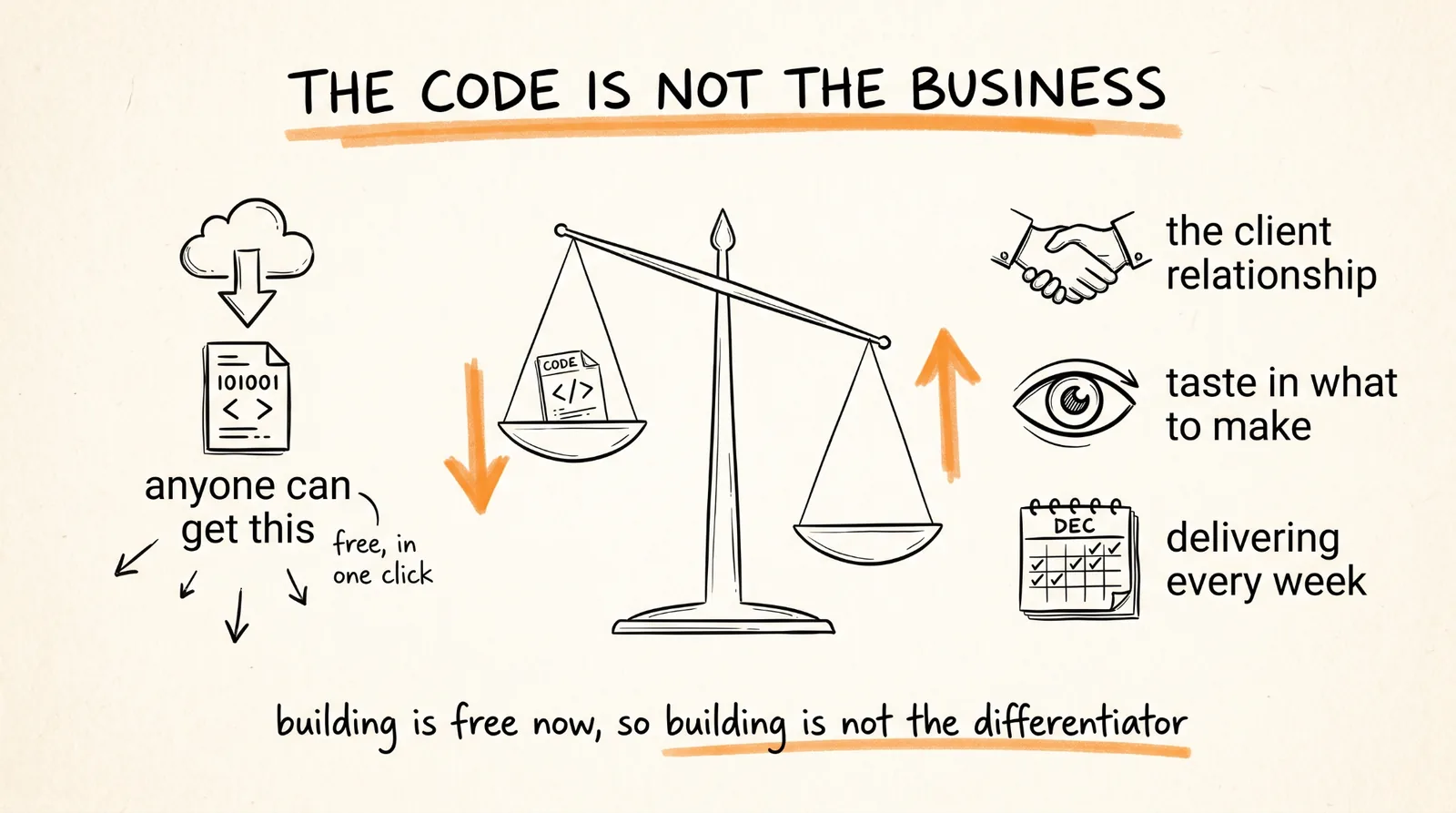
Three things are true of every repo on this list.
The code is free and the business is not the code. Every one of these is a tool that thousands of people can now download, so what you are selling is the client relationship, the taste in what to make, and the reliability of actually delivering every week. AI made building nearly free, which means building is no longer the differentiator.
The rules are where the money is lost. Licensing on Remotion, likeness and disclosure on PersonaLive, platform policy on RedInk and KDP. Everyone shipping content about these repos is competing on excitement, so the person who reads the license is competing on something nobody else bothered with, and it is the thing that determines whether you have a business in six months or a suspended account.
Pick one, not six. Each of these is a real business with real customers to find, and the person making money picked the one closest to what they already know and shipped it.
Before You Build on Any of Them
Open the LICENSE file first, every time, before you write a line. MIT and Apache 2.0 mean go ahead. Anything else means read it, especially if you plan to sell what you build.
Read the terms of any platform you are publishing to, not a summary of them. The platform rules in this guide are current as of writing and they change constantly.
Install from the original repository, not a fork.
And disclose AI where the platform asks. On KDP it is free and protects your account. On social platforms it is increasingly required. The disclosure has almost never been the thing that hurt anyone. Hiding it is what does.
The Recap
Autoclip for a clipping service, Remotion for high-volume video with a real license threshold at 4 people, OpenHands for development services if you can review the code, PersonaLive for AI presenters with consent and disclosure sorted first, RedInk for a genuinely underserved market with real access friction, and MuMuAINovel for publishing if you disclose and publish fewer, better books.
The repos are free. The homework is what makes them a business.
Don't want to figure this out alone? I walk members through every step inside the community. Join the Skool → skool.com/raycfu