
How to Make Your Writing Not Sound Like AI
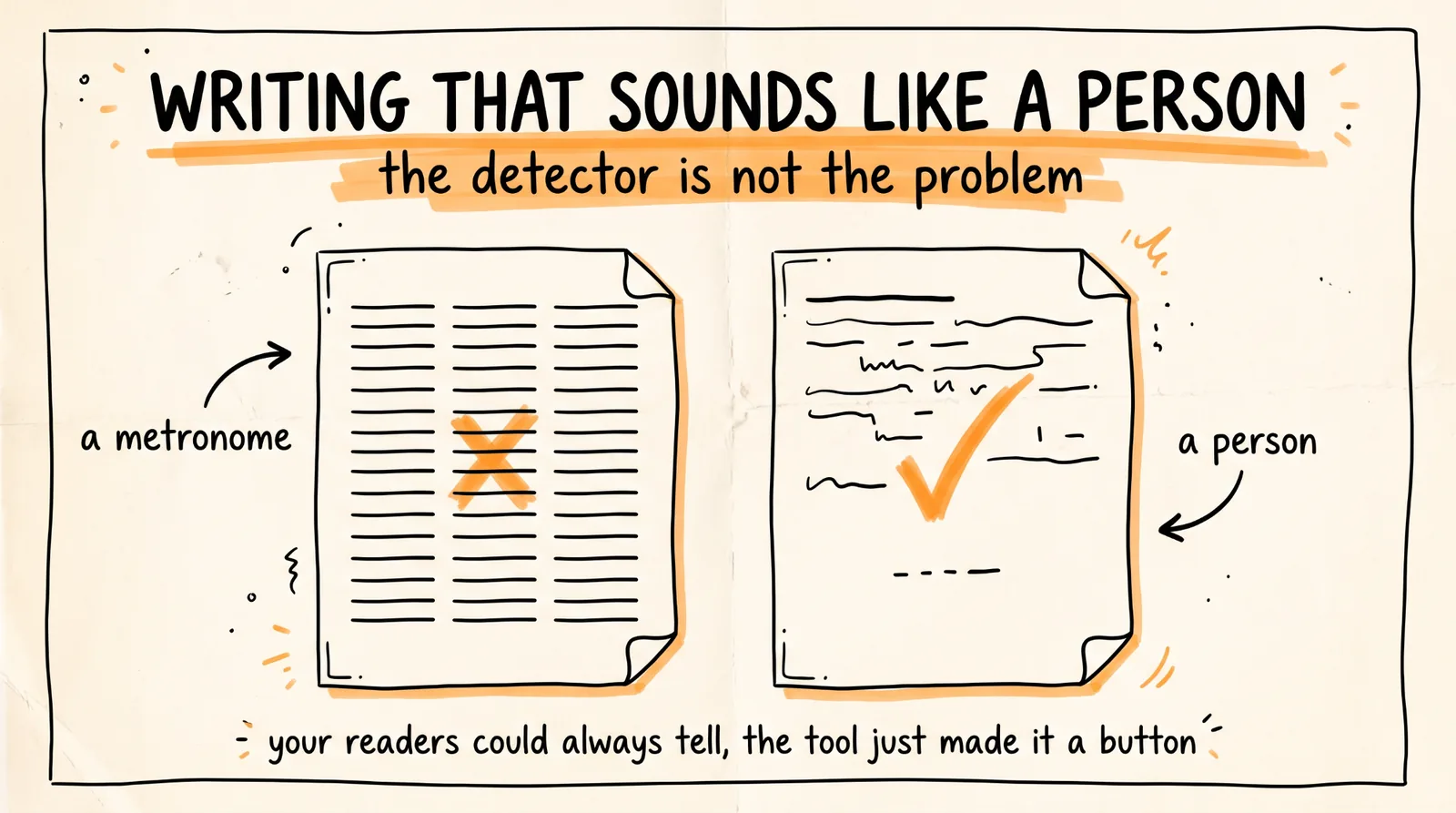
This is the full guide from the video. Substack launched an AI detector called Pangram in July, and LinkedIn, Medium, and everywhere else are heading the same way. But the detector is not really the problem.
The problem is that your readers already know. They knew before any tool existed. They can feel it in the third paragraph, and the moment they feel it they stop trusting you, which costs you more than any score ever will.
Part 1: The Tells
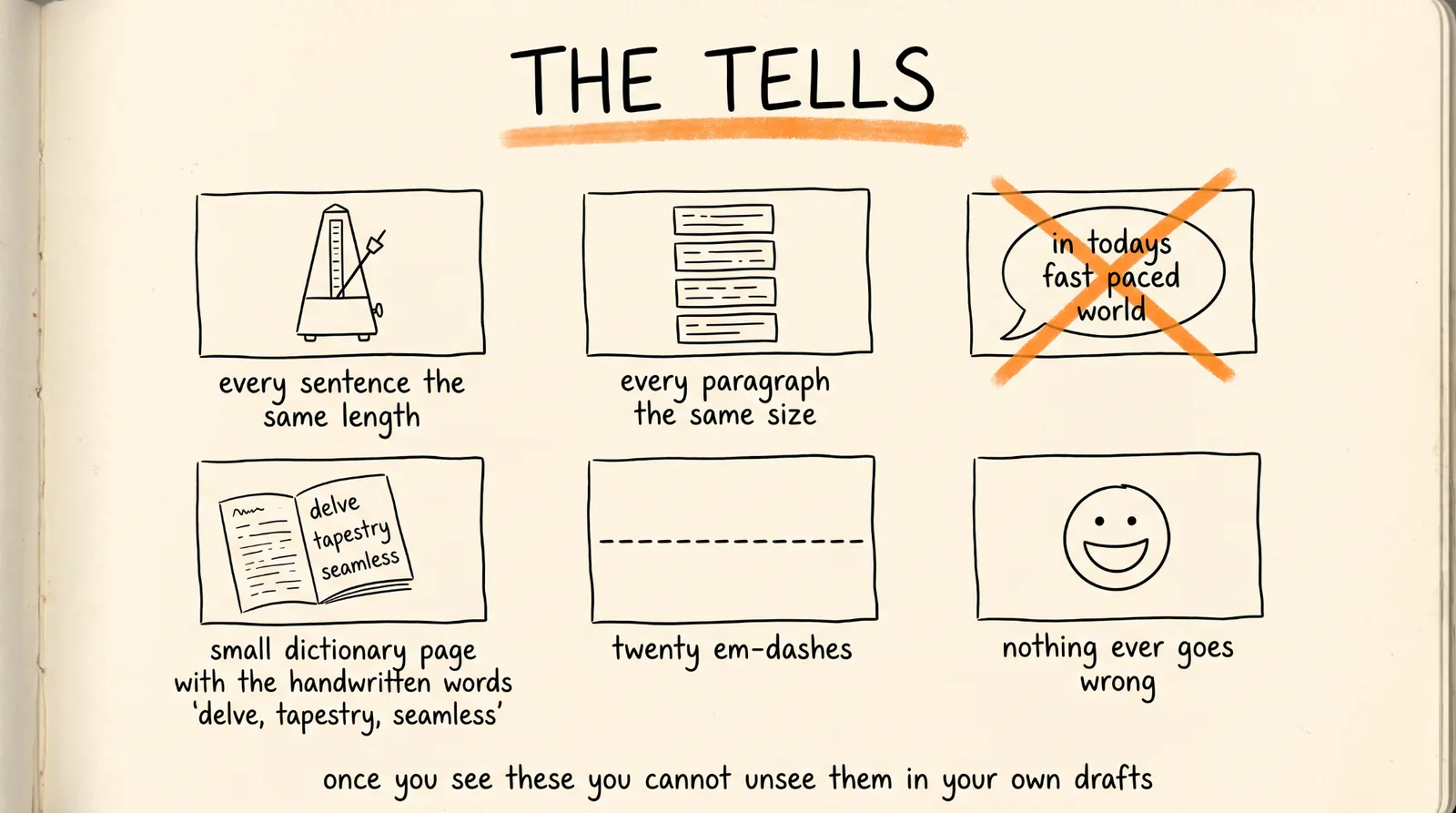
You do not need a detector to spot AI writing. Here is what gives it away, and once you can see these you cannot unsee them in your own drafts.
Every sentence is the same length. This is the biggest one by far. AI writes in a steady 15 to 20 word rhythm, sentence after sentence, and the metronome effect is what makes a page feel synthetic before you have consciously noticed anything. Human writing lurches. A short one. Then a long one that runs on and doubles back on itself and adds a clause nobody needed.
Every paragraph is the same size. Three sentences, three sentences, three sentences. Real paragraphs are uneven because real thoughts are uneven.
The openers and closers. "In today's fast-paced world." "As we move forward." "In an era where." "It is important to note that." These are throat-clearing, and no person who actually wanted to say something starts that way.
The vocabulary. Delve. Tapestry. Leverage. Seamless. Robust. Landscape. Navigate. Underscore. Realm. Testament. None of these are bad words. They are just words that appear at a rate no human hits by accident.
The em-dash pileup. One is fine. Twenty in an article is a fingerprint.
Relentless positivity. Everything is exciting, every tool is powerful, nothing has a downside, nobody is annoyed about anything. Real writing has complaints in it. Real writing says this part is tedious, this thing broke, I was wrong about that.
Perfectly balanced structure. Three benefits, each with three sub-points. Every section the same length. Reality is lumpier than that, and writing that mirrors reality is lumpy too.
The confident vagueness. "Significantly improved." "A wide range of businesses." "Numerous benefits." No numbers, no names, no specifics, because the model does not have any.
Part 2: What Actually Makes Writing Sound Human
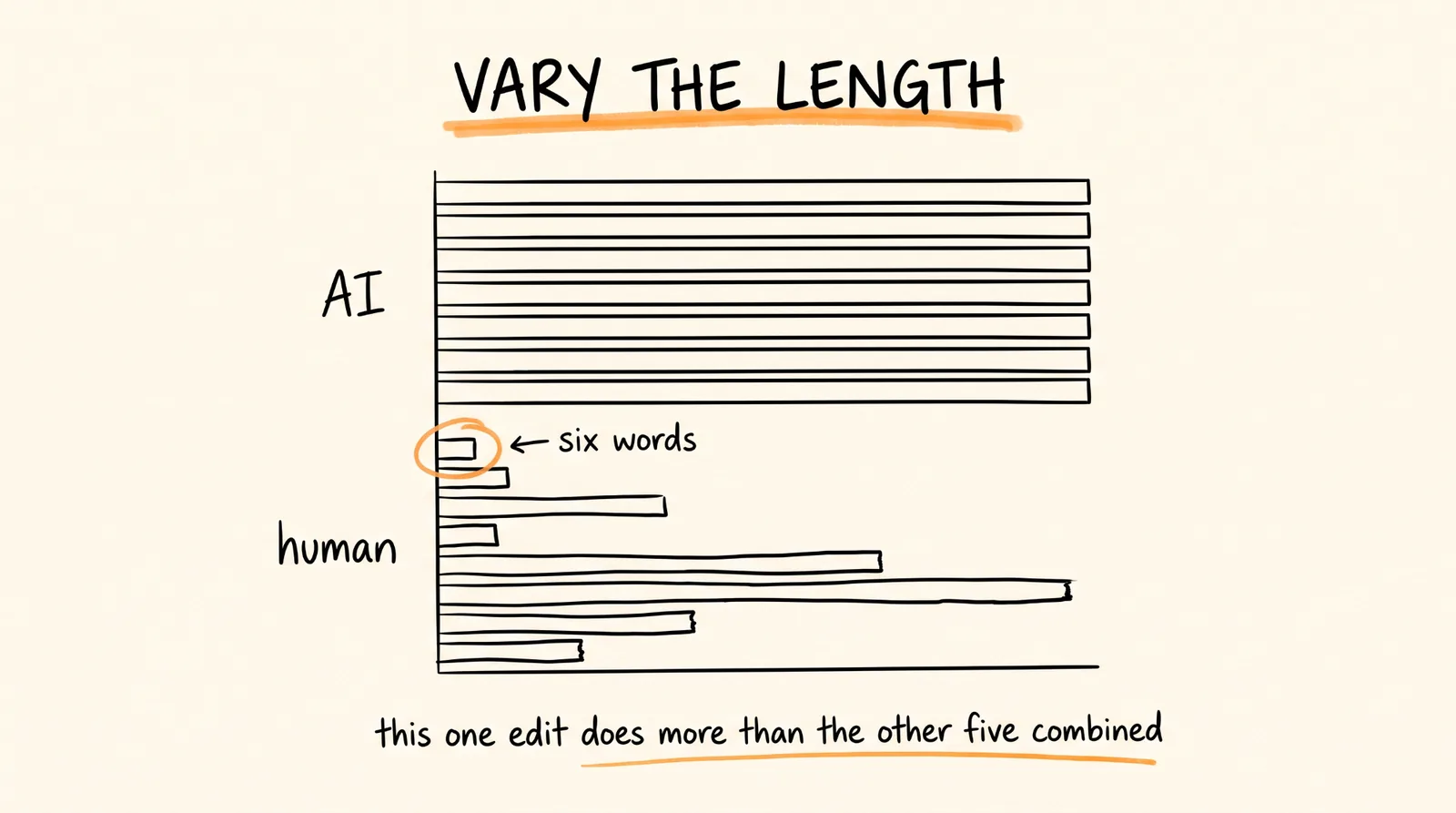
Six things, and the first one matters more than the other five combined.
Vary your sentence length, deliberately. This is the single highest-impact edit. Read your draft and count. If most sentences land between 15 and 25 words, you have found the problem. Fix it by writing a six word sentence, then one that runs forty words and takes a detour halfway through because that is how people actually think when they are working something out on the page. Then a short one. That variation is what a metronome cannot fake.
Use contractions. Don't, isn't, you're, it's. Formal writing avoids them. Nobody talks that way, and almost nobody writes well that way either.
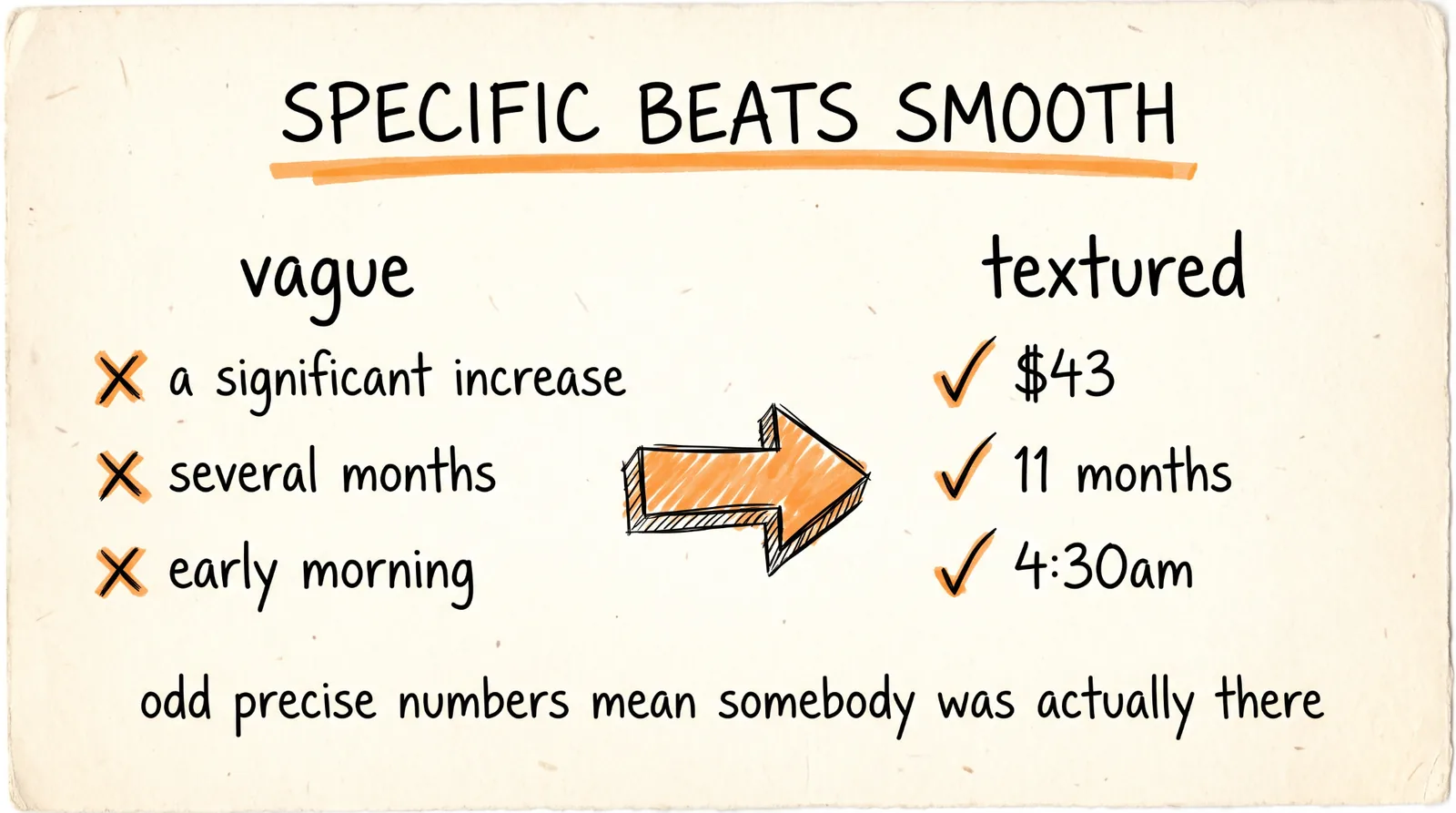
Use specific numbers with texture. Not "a significant increase," but $43. Not "several months," but 11 months. Not "early morning," but 4:30am. Odd, precise numbers signal that someone actually knows the thing, because vague quantities are what you write when you do not.
Start sentences with And, But, or Because. Your English teacher was wrong. Every good writer does this. It is how spoken emphasis lands on a page.
Put in one single-sentence paragraph. Somewhere in the piece, let one line stand completely alone.
Like that.
Include something negative. One complaint, one thing that did not work, one part you find annoying. Uniform enthusiasm is the loudest tell on the list, and one honest gripe does more for credibility than three paragraphs of proof.
Part 3: The Editing Pass
Here is the prompt to run on any draft. Note what it is doing, it is not disguising the writing, it is fixing the things that make writing bad:
Edit this draft so it reads like a person wrote it. Do not rewrite it into something else, keep my argument, my structure, and my facts exactly as they are.
Fix these specifically:
1. Sentence length. Count the sentences. If most fall between 15 and 25 words, break that pattern up. Put in some very short sentences. Let at least one run long. Read it back for rhythm.
2. Paragraph length. Make them uneven. Add at least one single-sentence paragraph where a point deserves to land on its own.
3. Cut every instance of: delve, tapestry, leverage, seamless, robust, landscape, navigate, underscore, realm, testament, elevate, unlock, harness, foster. Replace with the plain word a person would say out loud.
4. Delete any opening like "in today's world" or "in an era where," and any closing like "as we move forward." Start with the actual point. End on the last real thing you have to say.
5. Add contractions everywhere they would naturally appear in speech.
6. Replace every vague quantity with a specific one. If I have not given you the real number, mark it [NEED NUMBER] rather than inventing one.
7. Reduce em-dashes to at most one per section.
8. Find any place where the tone is uniformly positive and flag it, so I can add a real limitation or complaint.
Then tell me what you changed and what still reads as generic, so I can fix that part myself.
That last line is the one that matters. The parts a model flags as generic are usually generic because you did not have anything specific to say there yet, and the fix is you, not another pass.
Part 4: The Honest Part About Detectors
Two things worth knowing, because the internet is full of confident nonsense about this.
Detectors are unreliable in both directions. Pangram's CEO puts their false positive rate around one in ten thousand, but detectors as a category have a documented history of misfiring on non-native English speakers and neurodivergent writers, whose natural rhythm and repetition read as synthetic to a classifier. If your genuinely human writing gets flagged, that is a known failure mode of the tool, not evidence about you. Substack lets you add a note about your process and dispute a score, and you should.
And no technique guarantees a result. Anyone selling you certainty about a probabilistic classifier is selling you something. What the techniques in this guide actually guarantee is better writing, which is the thing that was worth having anyway.
Which brings up the part nobody in this conversation says out loud. There is a difference between using AI to draft your own thinking and then editing it into your voice, which is what every working writer does now, and passing off machine text as work you did not do. The first is a tool. The second is what Substack's CEO named "Claudefishing," where a reader pays for a person and gets a model instead. Readers can tell eventually, and the ones who feel misled do not come back.
So the rule that keeps you on the right side of it: use AI to write faster, never to have opinions you do not have. Put your actual numbers in it, your actual clients, the thing that actually broke last Tuesday. That is the part no detector can flag and no model can fake, and it is also the only reason anyone subscribes to a person instead of just asking the model themselves.
And where disclosure is required, disclose. Schools, journalism, some client contracts, anywhere someone specifically asked. Not because a detector might catch it, but because the whole value of your name on a piece is that it means something.
The Recap
Learn the tells: uniform sentence length, uniform paragraphs, the vocabulary list, em-dash pileups, and relentless positivity. Fix them by varying sentence length above everything else, using contractions, putting in specific textured numbers, starting sentences with And or But, letting one line stand alone, and including one honest complaint.
Run the editing prompt on every draft, then fix the parts it flags as generic yourself, because that is where the actual writing happens.
Don't want to figure this out alone? I walk members through every step inside the community. Join the Skool → skool.com/raycfu