
How to Build an AI Agent That Sells Pool Installations
Don't want to figure this out alone? I walk members through every step inside the community. Join the Skool → skool.com/raycfu
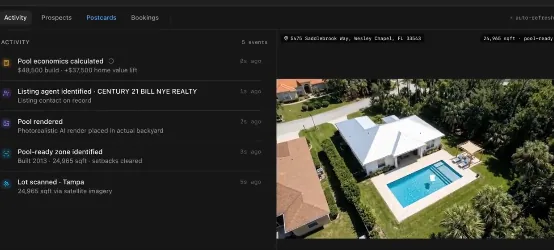
The pool industry does $24.8 billion a year in the US. The average inground pool costs $60K to $120K to install. Most pool companies still find customers through yard signs, word of mouth, and generic mailers. An AI agent that delivers personalized before-and-after renders of a homeowner's actual backyard with a pool in it is something none of them have ever seen. That is why they pay for it.
WHY THIS WORKS
A generic postcard that says "Want a pool? Call us!" gets thrown away. A postcard that shows the homeowner their own backyard with a $90K infinity pool, spa, and landscaping rendered into it gets pinned to the fridge. The conversion rate difference between generic outreach and personalized visual outreach is massive.
The math for the pool company: an average inground pool nets them $18K to $22K in gross profit. If your agent generates even 2 extra conversions per month, that is $36K to $44K in additional gross profit for them. They are paying you $3K/month for a system that returns 10x or more. That is a no-brainer sale.
THE SYSTEM: HOW IT WORKS END TO END
The agent runs a pipeline with 6 stages. You set it up once per market area and it runs continuously, generating fresh leads every week.
STAGE 1: FIND THE LEADS
The agent searches Zillow, Redfin, and public property records for homes that match your target profile.
Filters:
Price range: $500K to $1.2M. High enough that the homeowner can afford a pool. Low enough that they are still looking for ways to increase their home value. Homes above $1.2M often already have pools.
No pool mentioned in the listing or property records. This is the core filter. You only want homes without pools.
Lot size: 5,000 square feet or larger. Anything smaller cannot fit a standard inground pool with proper setback requirements.
Single family residential only. No condos, townhouses, or multi-family.
Ownership change within the last 3 years preferred. New homeowners are significantly more likely to invest in upgrades than someone who has owned the property for 15 years and clearly chose not to build a pool.
How to implement this:
Use the Zillow API or a real estate data provider like ATTOM Data, PropStream, or BatchLeads. These services provide property data including lot size, pool presence, ownership history, and sale price. Most offer API access or bulk export.
For public records, county assessor websites often have searchable databases. Some agents scrape these directly but API-based services are more reliable and legal.
If you are building this with OpenClaw or Claude Code, create a skill that connects to your data provider's API, runs the search with your filters, and returns a structured list of matching properties.
Target 50 to 100 leads per batch per ZIP code. Run weekly to catch new listings and recent sales.
STAGE 2: PULL PROPERTY DATA
For each lead that passes the filters, the agent extracts:
Full street address Owner name (from public records if available) List price or recent sale price Lot size in square feet Year built Bedroom and bathroom count Days on market or most recent sale date Property type confirmation (single family)
Store all of this in a structured format. Each lead gets its own record with all fields populated. Missing fields get flagged but do not disqualify the lead.
If owner names are not available through your data provider, you can cross-reference with county tax assessor records which are public in most US states. Services like PropertyShark, BeenVerified, or the county clerk website can fill in gaps.
STAGE 3: FETCH THE BACKYARD IMAGE
This is the visual foundation for the entire system.
Option 1: Google Maps Static API in satellite view. Use the property coordinates with a zoom level that captures the backyard. This gives you an aerial view showing the lot, the house footprint, and the open backyard space. Cost is fractions of a penny per image.
Option 2: Google Street View Static API. Sometimes gives a rear view of the property depending on street access. Less reliable for backyards but useful as a supplementary angle.
Option 3: Nearmap or EagleView for high-resolution aerial imagery. More expensive but significantly better image quality. Worth it for premium markets.
If no usable backyard image is available for a specific property, flag it and move on. You can either skip the lead or use a generated baseline image that matches the home style and lot dimensions.
Save each image with the property address as the filename for easy matching later.
STAGE 4: RENDER THE POOL
This is the step that makes the entire system work. You take the real backyard image and use AI image generation to render a luxury inground pool into it.
How to approach the render:
Match the pool style to the home. Modern and contemporary homes get infinity edge or geometric pools with clean lines. Traditional and Mediterranean homes get freeform or lagoon style pools with natural stone. Craftsman and ranch homes get classic rectangular pools with simple coping.
Include more than just the pool. Every render should show a spa or hot tub attached to the pool, stone or concrete coping around the edge, a deck or patio area, landscaping (palms, hedges, or garden beds depending on the region), and pool furniture if the image has room.
Use 16:9 aspect ratio at 2K resolution minimum. These need to look professional enough to print on a postcard.
Tools for the rendering:
Midjourney or DALL-E with inpainting. Upload the satellite image, mask the backyard area, and prompt the AI to fill it with a pool matching the style description. This requires some prompt engineering but produces excellent results.
Higgsfield or Runway for video renders if you want to go beyond static images. A 5-second video showing the empty backyard transforming into a pool oasis is extremely compelling for digital outreach.
ComfyUI with ControlNet for maximum control over the render. More technical to set up but gives you the most consistent results at scale.
For the OpenClaw or Claude Code implementation, build a skill that takes the backyard image and the home style classification as inputs, constructs the appropriate prompt, sends it to your image generation API of choice, and saves the output.
Quality check: Every render should look like a realistic architectural visualization, not an obvious AI image. If the pool is floating above the ground or the perspective is wrong, regenerate it. Bad renders hurt credibility.
STAGE 5: BUILD THE LEAD CARD
For each property, the agent compiles a lead card containing:
BEFORE IMAGE: The actual satellite or street view of the backyard as it exists today.
AFTER IMAGE: The AI-rendered version with the luxury pool, spa, landscaping, and deck.
ESTIMATED POOL BUILD COST: $60K to $120K depending on lot size, pool style, and regional pricing. You can refine this per market by talking to your pool company clients about their actual pricing tiers.
ESTIMATED HOME VALUE LIFT: 8 to 12% of current home value. On a $750K home, that is $60K to $90K in added value. This is a real selling point for the homeowner because the pool essentially pays for itself in equity.
OUTREACH PRIORITY SCORE: Rate each lead from 1 to 5 based on:
- New ownership (bought in last 3 years): +2 points
- Lot size over 8,000 sqft: +1 point
- Price tier $700K to $1M (sweet spot): +1 point
- Neighborhood has high pool density (comps show pools add value): +1 point
SUGGESTED OUTREACH HOOK: One personalized sentence for the postcard or email. Examples:
"Your 9,200 sqft lot on Maple Drive has the perfect layout for a resort-style pool and spa."
"New homeowners at 142 Oak Street: here is what your backyard could look like by next summer."
"At your home's current value, a pool addition could add $72,000 in equity while giving your family a private retreat."
The agent generates these hooks automatically based on the property data. Each one references the actual address, lot size, or value to make it feel personal.
STAGE 6: COMPILE AND DELIVER
The agent assembles all lead cards into a report. Two delivery formats:
DIGITAL REPORT: A clean markdown or PDF document with all leads organized by priority score. Each lead gets its own section with both images, all data points, the cost estimate, the value lift estimate, and the outreach hook. Email this to the pool company weekly.
PRINT-READY POSTCARDS: For each lead, generate a print-ready postcard file (front: after image with the outreach hook, back: before image with company contact info and a QR code to a landing page). The pool company sends these to a print-and-mail service like Lob, PostcardMania, or Click2Mail. Some of these services have APIs so you can automate the mailing entirely.
The pool company reviews the report, approves which leads to contact, and either mails the postcards or has their sales team call the highest-scored leads directly with the render as a visual aid.
HOW TO SELL THIS TO POOL COMPANIES
WHO TO TARGET
Start with pool builders and installers in Sun Belt states (Florida, Texas, Arizona, California, Nevada, Georgia). These markets have the highest pool demand and the longest building seasons. Look for companies doing $1M to $5M in annual revenue. Big enough to afford $3K/month, small enough that they do not have an in-house marketing team.
Find them on Google Maps, Yelp, HomeAdvisor, Angi, or the Association of Pool and Spa Professionals (APSP) directory. Most have a phone number and an email on their website. Many are active on Facebook and Instagram posting photos of completed pools.
HOW TO PITCH
Do not lead with AI. Lead with the before-and-after render of a real property in their service area.
Before you even reach out, run your agent on 5 to 10 properties in their ZIP code. Generate the full lead cards. Then send them an email or DM with one of the renders attached and say:
"I found 8 homeowners in [ZIP code] who have the lot size and budget for a pool but do not have one yet. I rendered what a pool would look like in each of their backyards. Here is one example. Want to see the rest?"
That email gets opened. That image gets clicked. No pool company has ever received a lead like that before.
PRICING
Setup fee: $1,500 to $3,000 one-time. Covers building the agent, configuring it for their service area, running the first batch of leads, and delivering the initial report.
Monthly retainer: $2,000 to $3,000/month. Covers weekly lead generation runs, image rendering, lead scoring, report delivery, and ongoing refinement of filters and targeting based on what converts.
Premium add-on: $500 to $1,000/month extra for automated print-and-mail integration where the postcards go out without the pool company lifting a finger.
The ROI pitch: One pool installation nets them $18K to $22K in gross profit. Your service costs them $3K/month or $36K/year. They need fewer than 2 additional sales per year from your leads to break even. Everything above that is pure profit. Most pool companies close 20 to 40% of qualified leads. If you deliver 10 scored leads per week, even a 5% close rate from your leads alone pays for the service multiple times over.
SCALING
10 pool company clients at $3K/month = $360K/year 20 clients = $720K/year
The agent runs the same pipeline for every client. You just change the ZIP codes, price ranges, and pool style preferences per market. The marginal cost of adding a new client is almost zero once the system is built.
You can also expand beyond pools. The same architecture works for:
- Solar panel installers (find homes with good roof exposure, render panels on the roof)
- Landscaping companies (render a new landscape design into the existing yard)
- Deck and patio builders (render a deck onto homes that do not have one)
- ADU builders (render an accessory dwelling unit onto properties with large lots)
- Fence companies (render fencing around unfenced properties)
Any home improvement business that sells a visual product can use this exact system. The pool version is just the most compelling because the before-and-after contrast is the most dramatic.
TOOLS AND COSTS
Real estate data API (ATTOM, PropStream, or BatchLeads): $50 to $200/month depending on volume Google Maps Static API: Fractions of a penny per image, essentially free at this scale AI image generation (Midjourney, DALL-E, or Higgsfield): $30 to $100/month depending on volume OpenClaw or Claude Code for orchestration: Your existing subscription Print-and-mail service (if offering that add-on): $1 to $3 per postcard including printing and postage
Total operating cost per client: roughly $50 to $100/month You charge $3,000/month That is 95%+ gross margin.
GETTING STARTED THIS WEEKEND
Day 1: Pick one ZIP code in a Sun Belt market. Run the lead search manually using Zillow and county assessor records. Find 10 properties that match the filters.
Day 2: Grab satellite images of each backyard. Use Midjourney or DALL-E to render pools into 5 of them. See how they look. Refine your prompts until the renders are professional quality.
Day 3: Build the lead cards for those 5 properties. Write the outreach hooks. Put it all in a clean document.
Day 4: Find 3 pool companies in that ZIP code. Send each one an email with one of your renders attached and the pitch from above.
You now have a working proof of concept and potential paying clients before you have even fully automated the system. Build the automation after you have a client paying for it. Not before.
You just read the full playbook. Most people will close this tab and never implement it. The ones who do usually hit a wall around the technical setup and quit.
Inside the Skool, I walk you through the exact build step-by-step, troubleshoot your setup live in the community, and share the scripts and templates I use to actually land paying clients.
If you want the shortcut instead of the long way around: