
How to Build a Wall Trading Firm with Claude
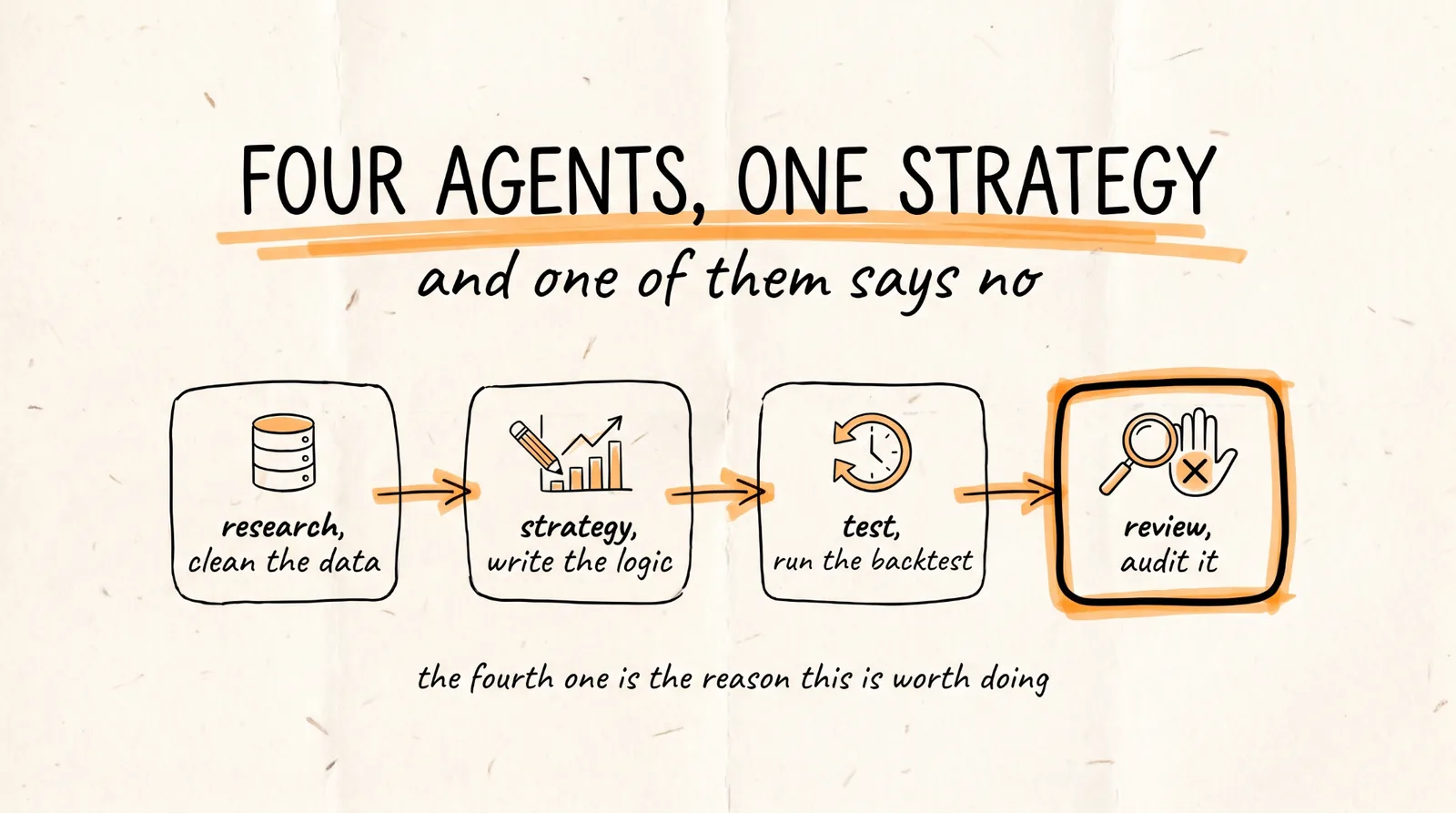
This is the full guide from the video. You give Claude an instruction like "build me a portfolio rebalancing model that rotates into the top performing tech stocks every month," and a team of agents goes to work: one pulls and cleans the market data, one writes the trading logic, one runs the historical backtest and calculates your win rate and maximum drawdown, and one audits the whole thing so you do not fool yourself.
Don't want to figure this out alone? I walk members through every step inside the community. Join the Skool → skool.com/raycfu
What to Install
There are a few Claude Code skill packages that give you this agent team. Two worth looking at.
For stock research, zubair-trabzada/ai-trading-claude runs 5 parallel agents (technical, fundamental, sentiment, risk, and thesis) and needs no API keys or data subscriptions, just Claude Code. Its own README describes it as a research tool only, not financial advice.
For strategy building and backtesting, which is what this guide is actually about, tradermonty/claude-trading-skills is the closer match. It includes a backtest expert, a strategy designer, and critically a strategy reviewer whose specific job is to check drafts for overfitting risk, sample size adequacy, and execution realism. That reviewer is the risk officer from the video.
Install by copying the skill folder you want into ~/.claude/skills for personal use, or into .claude/skills inside a project. Claude Code picks up changes in an existing skills directory automatically, and you only need to restart if you just created that directory.
Check the license on whatever you install, and install from the original repo rather than a fork.
The Four Agents and What Each Actually Does
The research agent pulls raw market data and cleans the price action. Unglamorous and the foundation of everything, because a backtest run on bad data produces a confident, precise, completely fictional result.
The strategy agent analyzes market structure and writes the actual trading logic, the entry rules, the exit rules, the position sizing.
The test agent runs the historical backtest and produces the numbers: win rate, maximum drawdown, Sharpe ratio, the equity curve.
The review agent audits all of it. Overfitting risk, whether the sample is big enough to mean anything, and whether the execution assumptions are realistic. This is the one people disable because it keeps saying no, and disabling it is how you end up trading a strategy that only ever worked on paper.
The Number That Should Shape Your Expectations
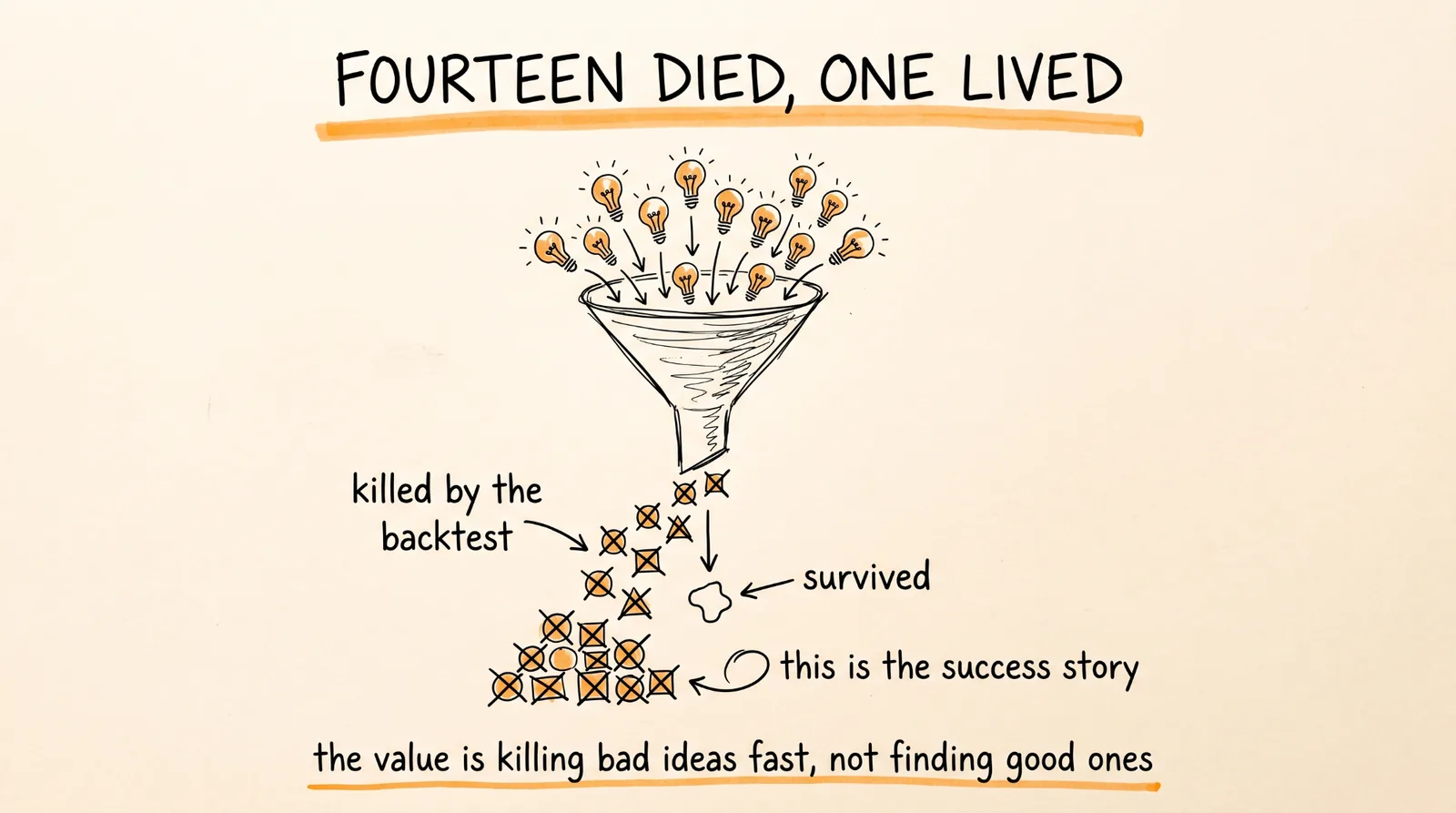
One developer documented giving Claude Code fourteen sessions and 961 tool calls to build a complete crypto trading bot, strategies, risk module, exchange integration, the whole thing. The backtests killed fourteen of the fifteen strategies.
Read that as the success story it is, not the failure it sounds like.
The value of this system is not that AI invents winning strategies. It is that AI lets you generate and kill bad strategies fast. Fourteen ideas that would have cost real money got eliminated for the price of some API calls, and one survived to be tested further. A human doing that by hand is looking at weeks of work per idea, which is exactly why most people never test properly and just trade the first thing that sounded good.
So the correct mental model is a strategy meat grinder. You feed ideas in, and almost all of them come out dead. When one survives, you have earned the right to be cautiously interested, not confident.
The Five Ways a Backtest Lies
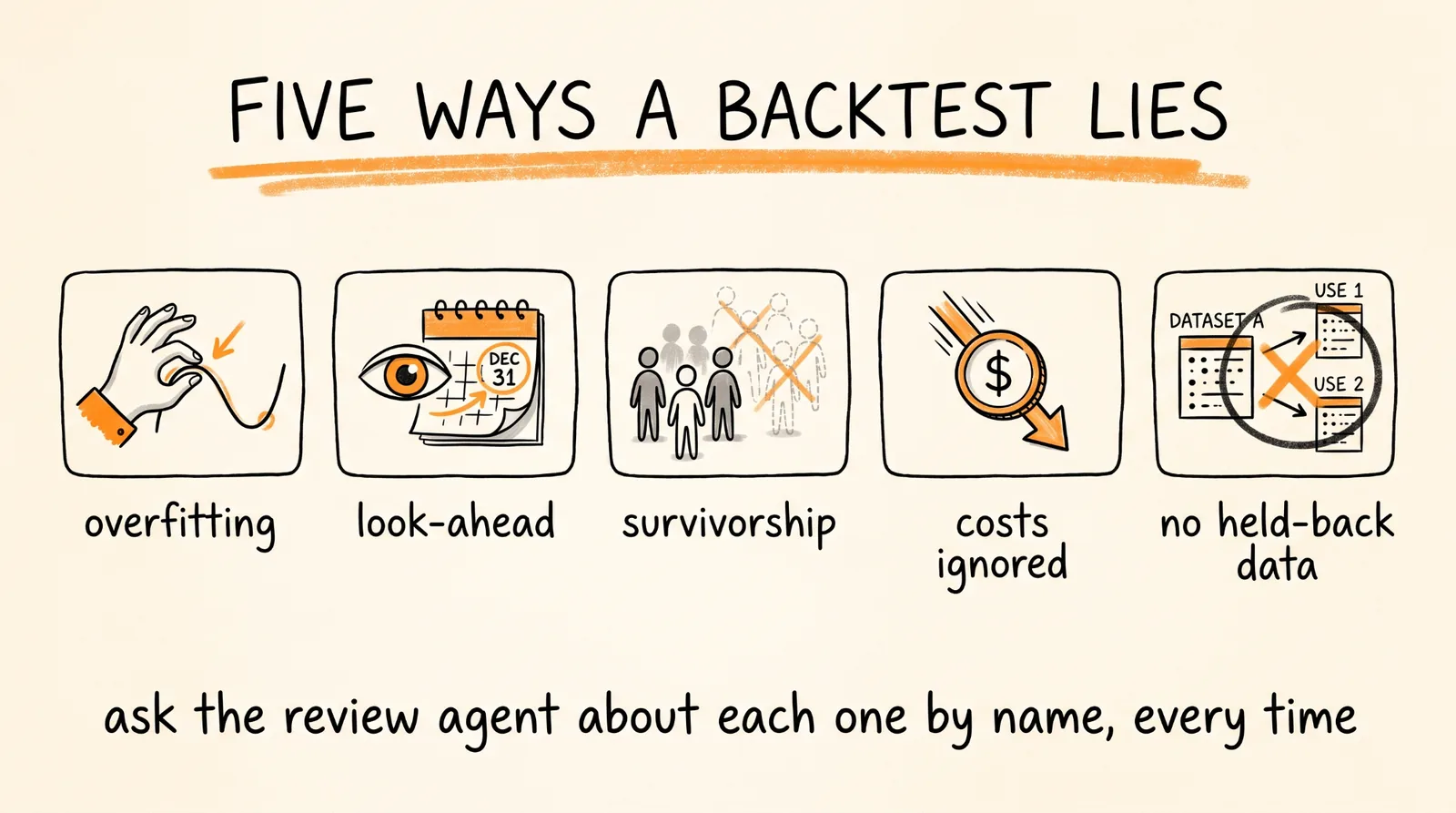
This is the part that decides whether this whole exercise makes you money or costs it, and it is why the review agent exists.
Overfitting is the big one. If you keep adjusting parameters until the backtest looks great, you have not found a strategy, you have described the past. A model tuned to perfection on historical data is memorizing noise, and noise does not repeat. The tell is a strategy with many parameters and a suspiciously smooth equity curve.
Look-ahead bias is when your logic uses information it could not have had at the time. Using a closing price to make a decision during that same day, or using data that was revised after the fact. This produces backtests that look magical and fail instantly in the real world.
Survivorship bias is testing against the companies that still exist. If your universe is "tech stocks" pulled today, every company that went to zero is missing, and your returns are inflated by a decade of failures you never had to live through.
Ignoring costs. Commissions, slippage, spread, and the fact that your fill price is not the price on the chart. A strategy that trades frequently can be profitable before costs and comfortably losing after them, and the gap is bigger the more it trades.
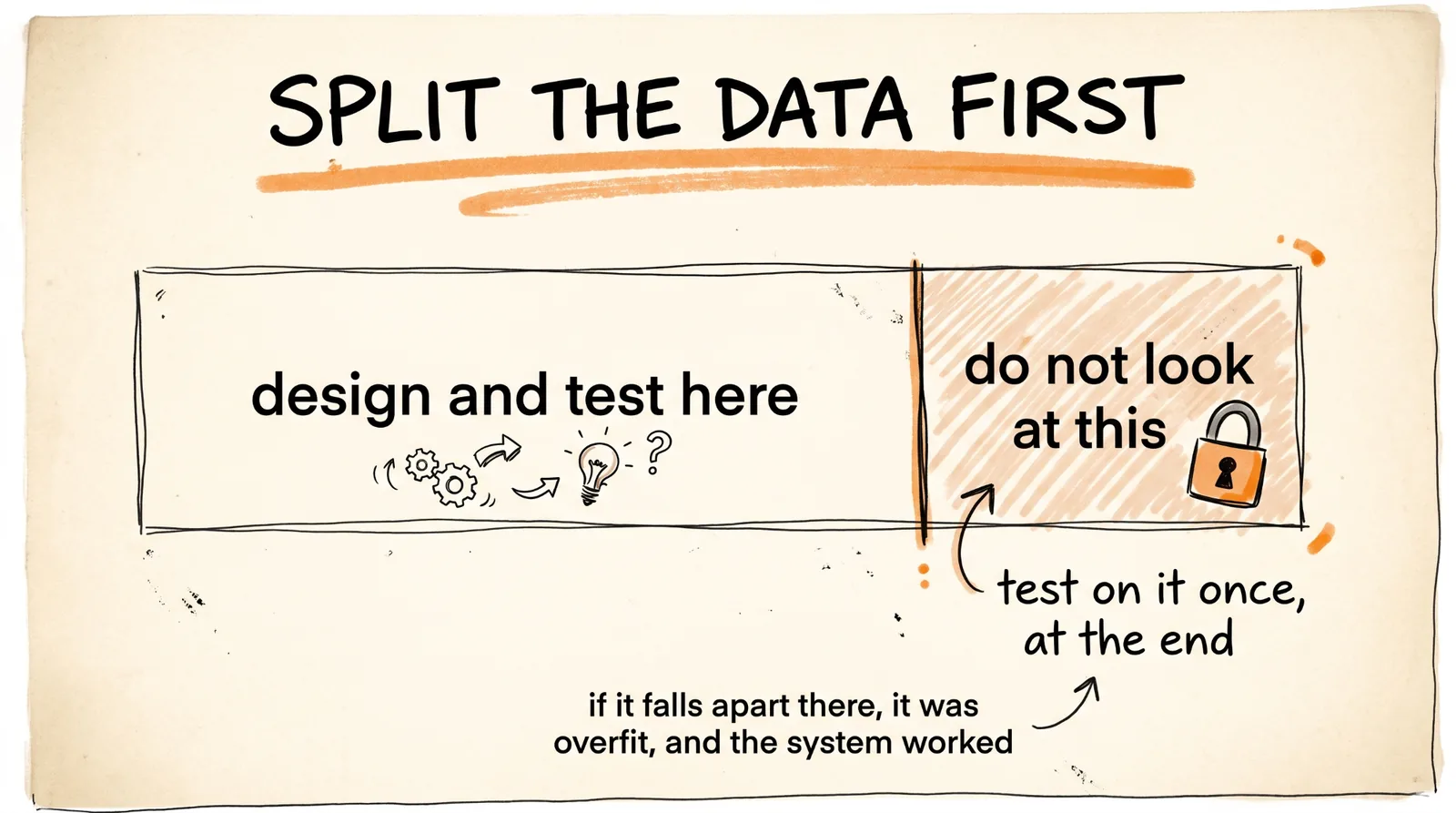
No out-of-sample test. If you designed and tested on the same data, you have proved nothing. Hold back a chunk of history the strategy has never seen, and only test on it once, at the end. Testing on it repeatedly turns it into in-sample data too.
Ask the review agent about every one of these by name, on every strategy, every time. And when it flags something, do not argue with it, because the whole reason it exists is that you will want to.
The Workflow That Actually Works
Start with a hypothesis you can state in one sentence, and one that has a reason behind it. "Momentum in tech rotates monthly because fund flows chase quarterly performance" is a hypothesis. "Find me something profitable" is a fishing expedition, and fishing expeditions overfit by definition.
Split your data before you write a single rule. Design and test on one period, hold the rest back, and do not look at it.
Keep the strategy simple. Fewer parameters means less room to accidentally curve-fit. If a strategy needs six tuned numbers to work, it probably does not work.
Run the review agent and take it seriously. Then run it again after any change.
Test on the held-back data once. If it falls apart, the strategy was overfit, and that is the system working correctly rather than failing.
Paper trade anything that survives for months. Live markets have costs, slippage, and behavior that no backtest reproduces.
And log everything, including the strategies you killed. The pattern in what fails is more instructive than the one thing that passed.
What This Is and What It Is Not
It is a genuinely powerful research accelerator. Work that took a quant weeks now takes an afternoon, which means you can test twenty ideas instead of one, and testing twenty is how you find out that nineteen of your instincts were wrong.
It is not an edge. Backtest performance is not future performance, the institutions using Claude in finance report saving analyst time rather than generating returns, and anybody showing you one month of live results with no audit trail is showing you a coin flip they got right.
Be especially skeptical of your own good results. The moment a backtest looks amazing, that is the moment to look for the bug, because in this domain a beautiful equity curve is more often evidence of a mistake than of an edge.
The Recap
Install the skills, give Claude a one-sentence hypothesis with a reason behind it, and let the four agents pull the data, write the logic, run the backtest, and audit the result. Split your data before you start, keep the strategy simple, ask the review agent about overfitting, look-ahead bias, survivorship bias, costs, and out-of-sample testing by name, and test on held-back data exactly once.
Expect most strategies to die. That is the system working. The fourteen that got killed are the value, and the one that survived still has to earn its way through months of paper trading before it deserves a dollar.
Don't want to figure this out alone? I walk members through every step inside the community. Join the Skool → skool.com/raycfu
IMPORTANT: This guide is for educational purposes only. Nothing here is financial advice. Trading involves real risk of loss. Never trade money you cannot afford to lose. Everything below is about building and testing strategies, and a strategy that looks good in a backtest is not a strategy that works. The whole point of this guide is learning the difference.